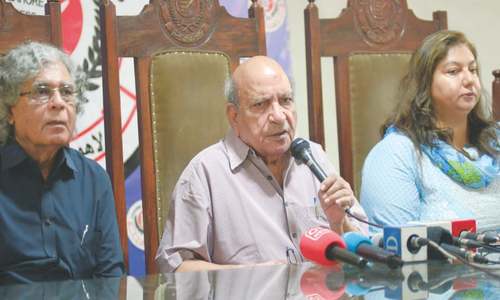
LAHORE: The council of the Human Rights Commission of Pakistan (HRCP) on Sunday expressed serious concern over, what it said was, recent attempts to undermine political opposition (in the country) and curtail freedom of expression, urging the need for criminalising enforced disappearances and protecting the rights of religious minorities.
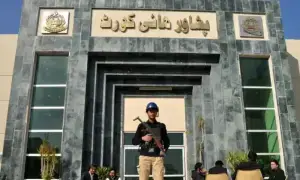
In a statement issued on behalf of its chairperson Dr Mehdi Hasan after its biannual meeting here, the HRCP maintained that it was seriously concerned over the government’s recent attempts to undermine political opposition. There were alarming signs that the role of parliament was receding. “The recently promulgated KP Actions (in Aid of Civil Power) Ordinance 2019 not only curtails certain fundamental rights, but it also runs contrary to democratic principles,” it said.
It said the government must take steps to implement the Supreme Court’s 2014 judgement to protect the rights of religious minorities. “Our reports show that Pakistan’s religious minorities remain vulnerable to faith-based discrimination and to the misuse of the blasphemy laws.”
Stresses need to criminalise enforced disappearances to hold perpetrators accountable
The statement said the HRCP’s recent fact-finding missions revealed that enforced disappearances were still being used as a means of coercion by state actors. There was an urgent need for legislation to criminalise this practice so that perpetrators were held accountable, it added.
It also said the surge in recent cases of child abuse pointed to the increasing brutalisation of society, and both the state and society must take responsibility for protecting children. The body condemned any measures by the state to curtail freedom of expression or to fragment the media through the introduction of media tribunals.
It demanded provincial status for Gilgit-Baltistan and all fundamental rights given to other citizens of Pakistan, for its people. It was perturbed by the resurgence of religious extremism in Khyber Pakhtunkhwa in the form of the KP government’s distribution of burqas among female students, saying such moves were blatant attempts to restrict women’s freedoms. It said rather than investing more in healthcare and education, the government appeared to be diverting resources away from these sectors.
The body said it was deeply alarmed by the lockdown in Kashmir by the Indian government and the subsequent war rhetoric from both sides of the border. Both India and Pakistan must recognise immediately that the people of Kashmir have the right to self-determination and that both countries have a duty to protect and promote regional peace.
Earlier, speakers at a seminar on reclaiming Pakistan’s civic space organised by the HRCP at its headquarters expressed concern over the way citizens’ fundamental freedoms were being compromised in Pakistan, urging the legal community, academia, human rights groups and civil society to jointly keep this from escalating.
Former HRCP secretary general and veteran journalist I.A. Rehman wondered who would question the state if it was not abiding by the Constitution.
“There has to be a civil society which can hold the state accountable. But for that, one needs a civil society that is organised and dynamic. Our state has gone into sectarianism because it does not want to be accountable to people,” he added.
He expressed concern over inflation, marginalisation of women and ban on 62 unions in Balochistan. Mr Rehman also demanded the authorities make public the report of a commission constituted by former chief justice of Pakistan Iftikhar Chaudhry on missing persons. He said the report had stated that only police had the authority to arrest any citizen, and those recovered from the custody of any other institution must be compensated.
Politician Afrasiab Khattak said the country had two systems – de jure (constitution) and de facto (the real management). He said efforts were being made to reverse the 18th Amendment, further claiming that there might be a national government in the near future. He said freedom of expression was the soul of a democracy, but political parties were silent over attempts to curb it.
He also said that for the first time, Punjab had demanded democracy. He hoped that this demand would gain strength, all democratic get together and people -- the real owners of the country -- would change its direction.
Activist Hina Jilani said people were being proceeded against without any legal framework. One could not talk of protecting human rights without protecting the human rights defenders. “We need recovery of the missing persons and not their figures,” she asserted.
She said civil spaces in Pakistan had shrunk, making it difficult to protect human rights. Politicians, bureaucracy and democratic institutions were being marginalised. It was the basic right of the people to criticise political parties, but it was also their duty to protect them.
Rights activists Muhammad Tehseen and Fareeha Aziz, journalist Badar Alam, Lums professor Ali Usman Qasmi and HRCP Secretary General Harris Khalique also spoke on the occasion, citing examples of how space for civil liberties was being shrunk in Pakistan, threatening basic human rights.
Published in Dawn, October 7th, 2019