Money launderers to get 10 years in prison, fine of Rs5m under approved bill


The National Assembly's Standing Committee on Finance on Tuesday approved the Anti-Money Laundering (Amendment) Bill, 2019, which prescribes punishments for offenders and outlines mechanisms for authorities to deal with such crimes in an effort to fulfil the Financial Action Task Force's requirements on curbing money laundering.
According to the approved Bill, violators of the law against money laundering will be subject to a prison sentence of up to 10 years instead of the previous two years, along with a fine of Rs5 million, up from the previous figure of Rs1m.
Furthermore, the investigating officer shall be authorised remand of the person for a period of 180 days, up from the previous 90 days, and shall not need to obtain arrest warrants from the court. The offender's assets will also be seized by authorities.
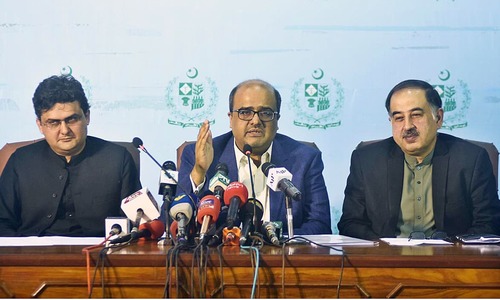
A session of the committee was held today in the Parliament House, Islamabad under the chairmanship of Asad Umar.
Federal Investigation Agency (FIA) Director General Bashir Memon, while giving a briefing to the committee, had called for the above-mentioned amendments to be made in the Bill.
State Bank officials in attendance had informed committee members that under the conditions provided by the Financial Action Task Force (FATF), the crime of money laundering must be reported immediately. They cautioned that legal action will be taken against bank employees who file erroneous suspicious transactions reports as well as against those who fail to report such transactions.
The committee also accorded approval to the Foreign Exchange Regulations Bill, under which the exchange of foreign currency will be controlled. If a person wishes to send or receive $10,000 or more within the country, permission from the State Bank will have to be sought first.
During the session's proceedings, committee members expressed reservations on the recommendations provided by the FATF to curb money laundering. Ayesha Ghous Pasha was of the view that "having turned FATF into a shield, the authorities were implementing an 'overkill' when it came to responsive measures".
"Where in the world does this occur, that an individual is barred from carrying foreign currency from one city to the other?"
To this, Asad Umar responded by saying: "FATF is giving us biased treatment. It is telling Pakistan to do what is done nowhere else in the world."
FATF compliance
Pakistan has so far avoided the FATF blacklist, but an October deadline looms large, when it will have to report back to the world financial watchdog that it has successfully implemented its own action plan to counter terror financing.
Pakistan, which ran an extensive diplomatic campaign to avoid blacklisting thus far, now has two major tasks before it.
The first is to convince the FATF by October that it has implemented its action plan. And the second is to win over 15 out of 36 FATF members to come off a grey list of countries which are monitored to ensure compliance.
Pakistan took a number of key measures recently to combat terror financing and money laundering, which also helped convince FATF member states not to put Islamabad on the blacklist.
The measures include banning currency transactions without a national tax number, disallowing open market conversion of more than $500 without submitting a copy of the national identity card, proscribing militant groups like Jamaat-ud-Dawa (JUD) and Jaish-e-Mohammad (JeM) and seizing their assets.