Taliban meet Afghan leaders, link peace to US pullout



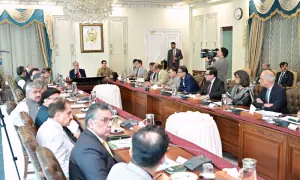
MOSCOW: A Taliban delegation including the group’s top political adviser met senior Afghan politicians in Moscow on Tuesday, saying they were committed to peace in Afghanistan, but insisting that international forces must leave the country for peace to be agreed, amid gathering diplomatic efforts to end the 18-year war.
In a message the Taliban have not altered since talks with the US started last autumn, Taliban co-founder and political leader Mullah Abdul Ghani Baradar said the insurgents want an end to 18 years of conflict — but would only sign a deal after foreign forces quit Afghanistan.
“The Islamic Emirate wants peace, but the first step is to remove obstacles to peace and end the occupation of Afghanistan,” Baradar said in a rare televised appearance, in what seemed to be a calculated move to establish his legitimacy as one of the main public faces of the Taliban, at the start of the two-day meeting marking 100 years of diplomatic ties between Russia and Afghanistan.
Mullah Baradar makes rare appearance in Moscow meeting
The Taliban, ousted by US-backed forces weeks after the Sept 11, 2001, attacks on the United States, refer to themselves as the Islamic Emirate.
“The obstacle is the occupation of Afghanistan, and that should end,” Baradar added.
Baradar — who helped Mullah Omar found the Taliban — was appointed its political chief in January following his release from a prison in Pakistan.
Tuesday’s Moscow meeting once again cut out senior members of President Ashraf Ghani’s government, which the Taliban consider a US-backed puppet regime, though the head of the Kabul administration’s high peace council, Mohammad Karim Khalili, attended.
Mr Khalili said dozens of people were being killed in fighting every day and it was time for a “dignified and just mechanism” to end the bloodshed.
Other Afghan politicians — including former president Hamid Karzai and candidates challenging Ghani in a presidential election slated for September — were also present.
The talks mark the second time Taliban leaders have met Afghan figures in Russia, following a February summit that saw the former foes praying together and chatting over meals.
Atta Mohammad Noor, the former governor of the northern province of Balkh and a leader of the mainly ethnic Tajik Jamiat-i Islami party, said it was in the interests of all sides to establish a good understanding. “We want to have good relations with the Taliban and we expect peace from them,” he said. The previous Moscow meeting had yielded “quite positive results”, he added.
Moscow appears to be gaining influence in the ongoing process, with the US announcing last month that Washington had reached a consensus with China and Russia on the key formula for a peace deal it is negotiating in Afghanistan.
Stalled US-led talks
But a recent sixth round of talks between US peace envoy Zalmay Khalilzad and the Taliban ended in Doha this month with no tangible progress cited by the negotiating teams.
While the Taliban insist foreign forces must leave Afghanistan before it can agree to peace, the US has refused to agree to a withdrawal until the Taliban put in place security guarantees, a ceasefire, and other commitments including an “intra-Afghan” dialogue with the Kabul government and other Afghan representatives.
Russian Foreign Minister Sergei Lavrov, who opened Tuesday’s meeting, said Russia and Afghanistan have “a shared aim — fighting terrorism” and reiterated that Moscow supports a complete withdrawal of foreign forces.
The Soviet Union and Afghanistan fought a war in the 1980s that resulted in Moscow’s withdrawal after nine years of brutal conflict.
Published in Dawn, May 29th, 2019