Poland cancels Israeli visit over WWII property restitution row


 9
9


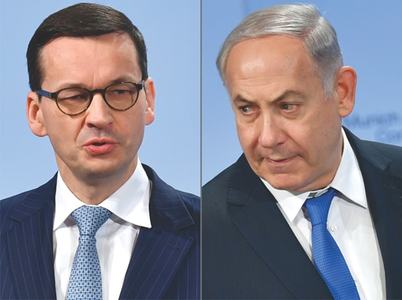
WARSAW: Poland on Monday said it had scrapped a visit by Israeli officials over their intention to raise the issue of the restitution of Jewish properties seized during the Holocaust, a matter Warsaw insists is closed.
“Poland decided to cancel the visit of Israeli officials after the Israeli side made last-minute changes in the composition of the delegation suggesting that the talks would primarily focus on the issues related to property restitution,” the foreign ministry said in a statement posted to its website.
It said a delegation headed by Avi Cohen-Scali, the director general of the Israeli Ministry for Social Equality, had been due in Warsaw on May 13.
The Israeli foreign ministry had no immediate comment. Nor did the social equality ministry, which was to have sent a delegate due to its role in safeguarding benefits for senior citizens.
Yair Lapid, co-leader of the main opposition Blue and White party, said Prime Minister Benjamin Netanyahu and Foreign Minister Israel Katz should stop debating Holocaust issues with Poland.
“The Polish government is again embarrassing Israel over the memory of the Holocaust,” he Tweeted.
“If Netanyahu and Katz do not halt this and stop negotiating on the subject the world will know that the memory of the Holocaust is not sacred to the government of Israel.” “Those who are prepared to negotiate with the Poles on the very memory of the Holocaust should not be surprised that in the end it places them in a shameful position,” Labour party MP Itzik Shmuli wrote on his Twitter account.
Several thousand nationalists rallied in the Polish capital on Saturday against a US law on the restitution of Jewish properties seized during the Holocaust, an issue which has surfaced ahead of parliamentary elections later this year.
The governing right-wing Law and Justice (PiS) party as well as the centrist and liberal opposition have downplayed the law signed by US President Donald Trump in May 2018, insisting that it will have no impact on Poland.
The US Justice for Uncompensated Survivors Today (JUST) Act — known as the 447 law — requires the State Department to report to Congress on the progress of countries including Poland on the restitution of Jewish assets seized during World War II and its aftermath.
On Monday the World Jewish Restitution Organisation (WJRO) said it was “disappointed in the tone and language in Poland regarding property restitution in recent weeks.” “We hope for a renewed dialogue with Poland so that they can address this historical injustice,” WJRO chair of operations Gideon Taylor added in a statement.
Pre-war Poland was a Jewish heartland, with a centuries-old community numbering some 3.2 million, around 10 percent of the population. Anti-Semitic concerns regarding Poland have recently resurfaced.
Last year, Warsaw passed a law that made it illegal to accuse the Polish nation or state of complicity in Nazi German war crimes. The move sparked an outcry from Israel, which saw it as an attempt to ban testimonials on Polish crimes against Jews.
In response, Warsaw amended the law to remove the possibility of fines or a prison sentence.
In February, Katz drew Poland’s ire by saying “Poles suckle anti-Semitism with their mothers’ milk”.
In April, the World Jewish Congress condemned a Polish town after reports that residents burnt an effigy “made to look like a stereotypical Jew” in a revival of an old Easter tradition.
Published in Dawn, May 14th, 2019