Islamic lunar calendar to be ready in two weeks


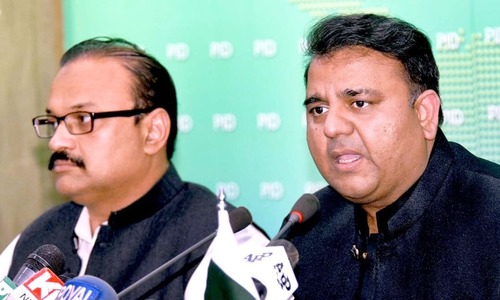
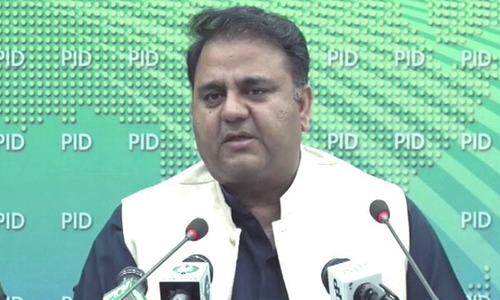
ISLAMABAD: Aiming to end perpetual uncertainty over moon-sighting in the country, federal Minister for Science and Technology Fawad Chaudhry announced on Wednesday that a calendar showing main Islamic dates and months for the next five years based on scientific evidence would be ready and placed before the cabinet by the 15th of Ramazan.
“We have tremendous respect for ulema and they may be good at their jobs but these elderly people can barely see people in front of them clearly let alone spot a fine crescent,” the minister said at a press conference.
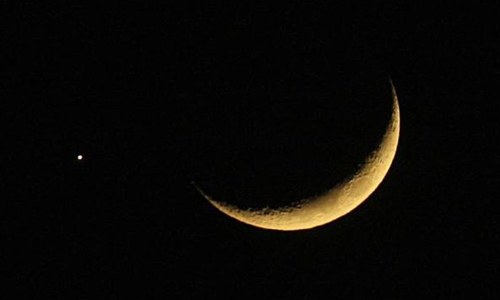
“We cannot understand the stubbornness of the ulema who insist on sighting the moon alone. Moon-sighting is a scientific process. Science can precisely tell the birth of the moon and that is why Imam Shafai described moon-sighting as an arithmetic process,” he said.
Explaining how the telescopes used by Ruet-i-Hilal Committee members were hundreds-of-years-old obsolete equipment, the minister said his office will rely on advanced telescopes of the Met Department.
Anticipating it may be opposed, Fawad says his ministry doesn’t intend to impose its findings
“A process has been developed on confirmed crescent sightings based on indisputable astronomical information, which nobody should object to,” the minister said.
Anticipating that the plan may face opposition, he said, “I reiterate that the ministry does not intend to impose its findings but provide an alternative opinion.”
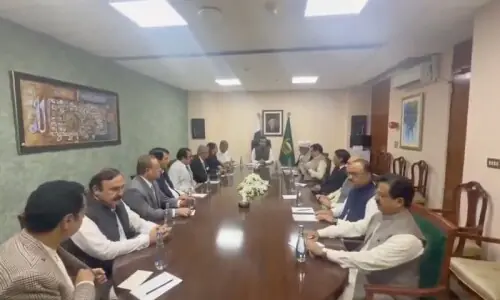
On May 3, Mr Chaudhry had formed a committee of five experts from the ministry of science and technology, Meteorological Department and the Pakistan Space and Upper Atmosphere Research Commission (Suparco) to determine moon-sighting for key Islamic dates and months scientifically putting an end to the practice of looking for it physically through telescopes.
Responding to a question about ulema cautioning the government to stay away from religious matters, Mr Chaudhry retorted, “Our interpretation of religion is better than theirs.”
Calculations accurate than sightings
A senior official of the ministry requesting anonymity told Dawn after the briefing that results show that with today’s technology, calculations are far more accurate than the claims of sighting.
“In the present era of scientific and technological advancements, more than four decades after man landed on the moon, some of us are still avoiding the use of scientific knowledge for making an Islamic calendar and having to wait till midnight for a confirmation of moon-sighting,” he said.
Mr Chaudhry had earlier questioned the wisdom of spending large sums of money on moon-sighting every year, saying that the Ruet-i-Hilal committee should voluntarily carry out the sighting of the moon.
He was critical of the committee, saying that around Rs3.06 million was spent on moon-sighting every year, and it was time to utilise science and technology to end the age-old controversy.
Nonetheless, these comments from the minister and his announcement to form a committee to end the moon-sighting controversy through science elicited a reaction from Ruet-i-Hilal Committee Chairman Mufti Muneebur Rehman, who cautioned the minister to refrain from commenting on religious matters.
He said the committee consulted experts while looking for the crescent.
Published in Dawn, May 9th, 2019