India votes in second phase of mammoth general election


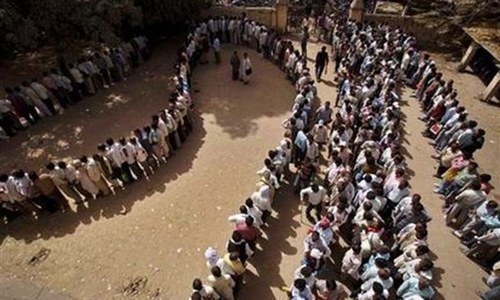
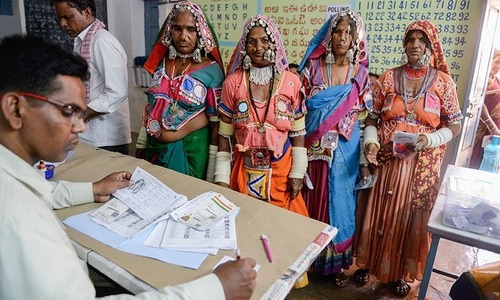
Voters across swathes of southern India began queuing up early on Thursday in the second phase of a mammoth, staggered general election in which opposition parties are trying to stop Prime Minister Narendra Modi from winning a second term.
More than 155 million people are eligible to vote in the second phase, which covers 95 parliament constituencies in 12 states including parts of Jammu and Kashmir. India's parliament has 545 members.
Kashmiri leaders had earlier called for a boycott of the vote, calling it an illegitimate exercise under military occupation. Most polling stations in the Srinagar and Budgam areas of Kashmir looked deserted in the morning, with more armed police, paramilitary soldiers and election staff present than voters. Voting was expected to be brisk in the Hindu-dominated Udhampur constituency of the region.
The focus will be on the southern states of Tamil Nadu and Karnataka, where the main opposition Congress party and its allies need to win big if they hope to oust Modi's Bharatiya Janata Party (BJP).
The BJP began the election as the frontrunner, with Modi setting muscular national security as his campaign plank after a spike in hostilities with Pakistan.
"If the non-BJP parties perform well in these two states, then they would still be having a chance of forming a non-BJP government at the centre," said Sanjay Kumar, director of the Centre for the Study of Developing Societies, a think tank based in the capital, New Delhi.
The BJP had secured a landslide majority in the 2014 general election, in part by winning sweeping victories in six northern states that gave the party 70 per cent of all its seats, said Neelanjan Sircar, an assistant professor at Ashoka University near New Delhi.
"You can never expect you'll do that again," he said. "Those seats that you lose, you'll have to make up somewhere."
Sircar also said the BJP would be looking to make gains in Karnataka.
The election began last week and will end next month in a giant exercise involving almost 900 million people.
Votes will be counted on May 23 and the results are expected the same day.
Modi and the BJP have run an aggressive campaign, playing to their nationalist, Hindu-first base and attacking rivals they accuse of appeasing minorities.
Critics say such divisive election rhetoric is a threat to India's secular foundations.
"Communal polarisation is obviously the biggest issue for me," said Rakesh Mehar, who voted in Karnataka's capital, Bengaluru. "And the growing intolerance in the country is what worries me the most."
A firebrand Hindu ascetic from the BJP who governs northern Uttar Pradesh was banned from campaigning for a few days because of anti-Muslim comments, India's election commission said on Monday.
The Congress party is focusing on concerns about rising unemployment and agrarian distress and is staking it campaign on a promise for a generous handout to India's poorest families.
Voters in Bengaluru, once a sleepy retirement town that has been transformed into India's technology hub, said they wanted lawmakers who would fix infrastructure problems such as traffic congestion and poor water management.
"We have been voting every time expecting a change but nothing has come so far. People are talking about national issues," said Manjunath Munirathnappa. "But only when they fix the local issues will there be progress in the nation."