IMF says its mission will visit Pakistan 'before end of April to continue constructive discussions'


The International Monetary Fund (IMF) on Monday said that it held "constructive discussions" with Pakistani authorities during last week's spring meetings in Washington and that its mission will be visiting Pakistan "before the end of April to continue the discussions" on a bailout package.
The announcement was made by the Office of the Resident Representative of the IMF in a press release following reports that the IMF mission's visit of Pakistan for finalising the package may be delayed as both sides are still engaged in an intense discussion.
"The Pakistani authorities and IMF staff held constructive discussions during the IMF/World Bank Spring Meetings in Washington DC towards an IMF-supported programme," the IMF statement said.
"At the request of the authorities, an IMF mission will be going to Pakistan before the end of April to continue the discussions."
Meanwhile, Minister for Revenue Hammad Azhar said that an "agreement in principle has been reached on all outstanding issues with IMF" and that "formalities will now be finalised during the IMF's staff level visit to Pakistan".
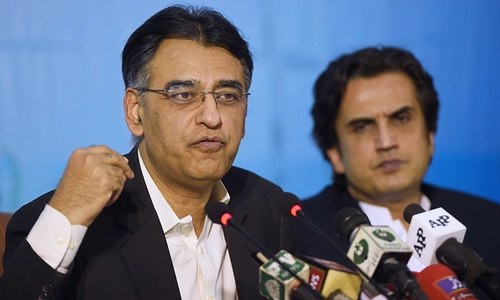
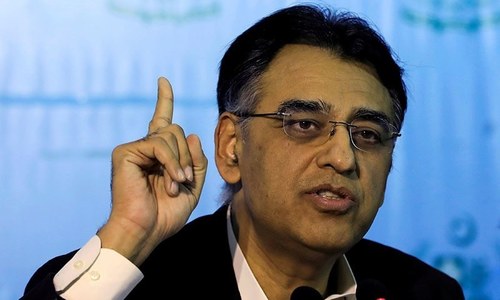
It is pertinent to mention here that Finance Minister Asad Umar, who led the Pakistani delegation at the spring meetings, had also said earlier this month that the mission would visit Islamabad soon and an agreement should be signed by the end of this month.
The finance minister went to New York on Friday but his team, which includes senior officials of his ministry and other government agencies, stayed in Washington for further talks — Dawn reported.
At a Thursday night news briefing in Washington, Umar had said the two sides had “more or less, reached an understanding” on the bailout package and “in a day or two, we hope to reach a full agreement”.
Another official familiar with the Pakistan-IMF talks said, “Islamabad still hopes to conclude the agreement before June, as they believe the bailout package would help budget prospects.”
The sources said that IMF officials were also seeking details of the China-Pakistan Economic Corridor (CPEC), along with a written guarantee from both Pakistan and China that the IMF assistance will not be used to repay loans to China.
Read: IMF, World Bank urge caution with China loans
The finance minister is likely to visit China on April 25 for talks on the IMF concerns over CPEC and IMF will wait to hear from him before it finalises the bailout package, the sources said.
Meanwhile, both sides are engaged in “fine-tuning” the details of the proposed IMF programme. Pakistan wants the IMF to review some of the conditions it has attached to the package while the IMF insists that those conditions are absolutely essential for a successful completion of the programme.
Pakistanis point out that this would be their 14th package with the IMF, if finalised. They argue that the conditions attached to previous programmes were also not fully implemented because they were too restrictive. Pakistan wants the IMF to focus on long-term structural reforms that help revive its economy instead of attaching conditions that would be difficult to implement.
During negotiations on the new package, the Pakistani delegation told the IMF that they “do not want to commit to what we cannot implement”.
When asked how much money did Pakistan expect from the IMF, a source said: “The amount and length of the programme also depends on the nature of the package. If the conditions are too restrictive, Pakistan would expect a larger package, i.e. more assistance for a longer period.”
Some of the conditions proposed by the IMF include: making the State Bank independent, a market-oriented exchange rate, expanding the tax target by Rs5,000 billion, ending income tax concessions, more taxes on salaries, narrowing the amount of taxable income from Rs12 lakh a year to Rs4 lakh, reducing electricity and gas losses, no government interference in Nepra and Ogra policies, Rs140 billion electricity and gas revenue losses be recovered from consumers.
The sticking points, however, are the demands for market-determined exchange rates and sharing details of Chinese loans which Pakistan is reluctant to do.
The IMF insists on full disclosure of all financial cooperation between Pakistan and China, including assistance related to infrastructure development, nuclear power plants, joint manufacturing of JF-17 Thunder fighter jets and procurement of submarines.
The IMF is also demanding details of more than $6.5bn of commercial loans Pakistan has received from China in the past two-and-a-half years.
In July, China also deposited $2bn with the State Bank of Pakistan.