CII terms handcuffing of suspects before conviction un-Islamic


ISLAMABAD: The Council of Islamic Ideology (CII) declared on Thursday that handcuffing of suspects by the National Accountability Bureau and law enforcement agencies as well as insulting them on the media before conviction was against Islamic principles and violated human dignity.
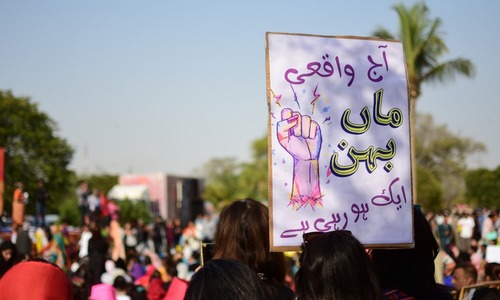
At the same time, the council continued its tradition of taking up issues related to women and expressed concern over what it termed “advances” implied in several slogans during Women’s Day rallies.
CII chairman Dr Qibla Ayaz told the media after the two-day council meeting that a committee had been formed under the supervision of retired Justice Raza Khan, a member of the council, to analyse the National Accountability Ordinance.
“The committee will review as to which sections of the law are in violation of Islamic laws,” Mr Ayaz said.
Read more: CII forms committee to suggest ways to establish Madina-like state
However, when asked about handcuffing of suspects by police and other law enforcement agencies, he said that it was an un-Islamic act.
Dr Ayaz declined to further elaborate but said, “Handcuffing can be allowed only when there is threat of violence by the accused”.
Incidentally, the CII had come up similar reservations in 2002 along with a set of rights to be followed by the authorities for treatment of suspects and prisoners.
The CII’s latest meeting also observed that “unethical and immoral” slogans were heard at the rallies held on March 8.
“We have noted that it was due to the decaying family system in the country and the council will try to determine the reasons for disintegration of the family system,” Dr Ayaz said, adding that it was the responsibility of the council under its mandate to suggest ways and measures for the Muslims of the country to live their lives according to principles of the Quran and Sunnat.
Read more: 1961 Muslim family laws not comprehensive: CII chief
“Such behaviour cannot be changed with charged slogans and rhetoric. There is a need to determine the reasons and environment leading to such actions (by participants of the Aurat march),” the CII chairman said.
The meeting also discussed the murder of Associate Professor Khalid Hameed, the head of the English department at the Government Sadiq Egerton College, Bahawalpur. “We have noted that the education system in the country needs an overhauling as there is lack of coordination and informal contacts between students and teachers. Besides healthy activities including extracurricular activities have almost died down,” Dr Ayaz said. “The [government’s education] policies are teacher-centric — about their salaries etc — but not student-centric and the youth of the country is under serious psychological pressures,” he added.
About the alleged forced conversion of two Hindu girls, the CII chairman said that their case was in the Islamabad High Court, adding that forced conversion was incorrect. However marriage of one’s free will outside one’s religion was another issue, he added.
“We [the council meeting] also took up the sale of liquor in the name of religions other than Islam. The CII will approach religious personalities of other religions to seek their opinion on liquor as the liquor sale permits are issued on the basis of other religions,” he added.
He said that the CII expressed concern over attacks on Christchurch mosques, and paid tribute to New Zealand Prime Minister Jacinda Ardern for her actions and decisions following the attack.
Published in Dawn, April 5th, 2019