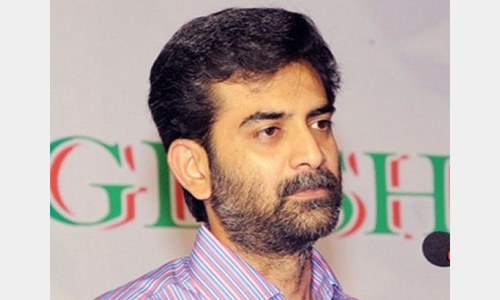
Another eyewitness testifies against Zubair alias Chariya in Baldia factory fire case

An eyewitness on Tuesday appeared before an anti-terrorism court in Karachi and testified against Zubair alias Chariya, one of the held accused in the Baldia factory fire case.
At least 250 factory workers were burnt alive in the worst industrial inferno in the country in several decades. Subsequent investigations suggested that the factory was put on fire over an issue of extortion money. Nine accused, including Muttahida Qaumi Movement lawmaker Rauf Siddiqui, Abdul Rehman alias Bhola and Zubair, have been charged with setting ablaze the garments factory in Baldia Town on September 11, 2012.
Take a look: Baldia factory fire case unlikely to be decided in near future
Special Public Prosecutor Sajid Mehboob Shaikh produced the eyewitness before the court who identified Zubair and said that the accused was present in the factory on the fateful day.
He said that initially Zubair along with his accomplices smoked hashish outside a washroom of a warehouse in the factory. The eyewitness — whose identity was concealed due to security reasons — said he saw Zubair taking out shopping bags filled with inflammatory material from his pocket and dropping them on the clothes in the warehouse.
He said the accused repeated the same action on the second floor. Zubair was smiling when the fire erupted, he said, adding that he was able to identify Zubair's accomplices as well.
During the cross-examination, the defence counsel asked the witness why he turned up to record his statement after the passage of so many years since the incident. The witness replied that he had feared for his life and so he fled to Punjab in order to protect himself. He added that he only decided to record his statement after the joint investigation team in the case assured him of security.
The court issued a notice to a judicial magistrate and adjourned the hearing till April 3.
In February, two witnesses had appeared before the court and deposed against Zubair. The had also said that the accused had smiled and smoked in the canteen as the factory was burning.
They had testified that they used to work in M/s Ali Enterprises under the supervision of Zubair, who was the in-charge of the finishing department.
On the day of the incident, they said, they had gone out and when they returned to the factory it was in flames. The witnesses testified that they rescued as many male and female workers as they could, but others perished in the fire.
They further said that they had seen Zubair smoking and smiling along with two or three other men in the canteen as other workers struggled to save themselves and their colleagues. The witnesses also mentioned that later Zubair was also seen on the rooftop smoking and smiling.
“When some angry workers tried to catch Zubair, he went inside the canteen and locked its door from inside and then escaped from the factory,” said the two witnesses.
According to the prosecution, the suspects allegedly acted on the instruction of the then head of MQM’s Karachi Tanzeemi Committee, Hammad Siddiqui, as the factory owners did not pay protection money.
A red warrant has already been issued for the arrest of Siddiqui. Initially, police had released Zubair citing lack of evidence against him but he was once again arrested after accused Rehman alias Bhola implicated him in a statement recorded before a joint investigation team, disclosing that he carried out the task of setting ablaze the factory through Zubair and some others.
The prosecution had listed around 670 witnesses in the case, but later gave up around 300 of them. According to the special public prosecutor, over 330 witnesses have been examined by the court so far.