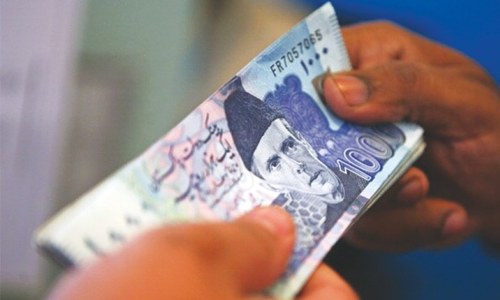
THE State Bank of Pakistan raised the key policy discount rate by 50 basis points on Friday, citing persistent inflationary pressures on the back of a high fiscal deficit, as well as continuing weaknesses on the external front despite a narrowing of the current account deficit and billions of dollars of bilateral inflows to shore up the reserves.
The rate hike is a continuation of a pattern that began in late 2017 when these pressures were building up, and is an unambiguous signal that despite the government’s triumphalist rhetoric of having plugged the external financing gap and stabilised the economy, much work remains to be done.
The rate hike will undoubtedly serve as a drag on the economy, which is already reeling under the weight of a severe contraction in the GDP growth rate, as well as adversely hit the fiscal framework by raising the cost of debt servicing for the government.
Since growth and fiscal deficit are at the heart of the government’s difficulties at the moment, it is worth thinking about why the State Bank would take a step that would negatively impact both priorities at the same time.
The answer is quite simple: the pressures weighing on the economy, far from abating, are only growing. With the current account deficit coming in at $8.8bn in the eight-month period from July to February, it means foreign exchange reserves are eroding at a rate of just above $1bn per month on average.
So with the $4bn in assistance from Saudi Arabia and the UAE, the government bought itself four months of time, which is now squandered. With the $2.2bn in Chinese assistance, the government has borrowed another two months, just enough time to get to an IMF programme.
Meanwhile, the fiscal deficit has grown faster as revenue shortfalls multiply each month and expenditures — particularly those that are security related — grow at the fastest pace in many years. And the current account deficit has narrowed, while exports have “remained flat” in dollar terms, as per the central bank.
Businesses are now choking on the fumes of the aggravated slowdown in the economy that these vulnerabilities have brought about. They are borrowing more but investing less.
As the slowdown ripples through the economy, nobody is left untouched by the spectre of inflation and unemployment. If the economy had made some sort of a turnaround, such a rate hike would not have been necessary, nor would the tone of the State Bank’s monetary policy statement been as gloomy as it is.
Serious maturity is needed at this time, and a completely unsentimental view of the economy must be taken. Slogans and rhetoric will not carry the country through; the tough choices that are looming ahead will require deft politics to manage. It is time to buck up.
Published in Dawn, April 1st, 2019