Slovakia elects its first female president

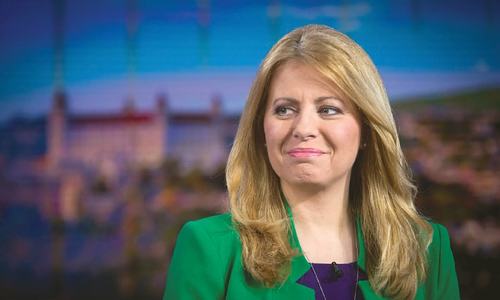
BRATISLAVA: Vocal government critic and anti-corruption activist Zuzana Caputova will become Slovakia’s first female president after provisional results showed she won Saturday’s run-off election.
Environmental lawyer Caputova got 58.40 per cent of the votes while EU energy commissioner Maros Sefcovic bagged 41.59 per cent, the Slovak Statistics Office said.
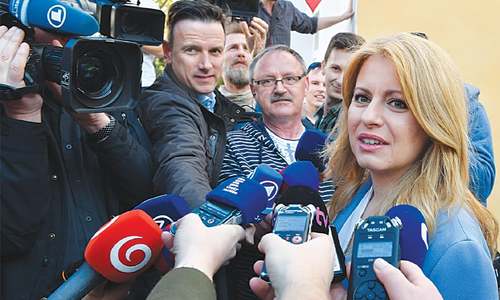
“Let us look for what connects us. Let us promote cooperation above personal interests,” Caputova said after her victory.
The 45-year-old lawyer added that the outcome was a sign that “you can win without attacking your opponents”. “I believe this trend will also be confirmed in the elections to the European Parliament and the Slovak parliamentary elections next year.”
Sefcovic, the 52-year-old ruling party candidate, called Caputova to congratulate her and planned to also send flowers.
“The first female president of Slovakia deserves a bouquet,” he told reporters.
Prime Minister Peter Pellegrini, who belongs to the governing Smer-SD party, said he expected “constructive cooperation”.
Outgoing President Andrej Kiska told reporters that “Slovakia is in a moral crisis and needs a president like Zuzana Caputova”.
“Many countries probably envy us for we have chosen a president who symbolises values like decency.”
Political novice Caputova, who ran on a slogan of “Stand up to evil” had earlier called the last few weeks “extremely challenging” and “an intense journey”.
No stranger to tough battles, Caputova won a 2016 award for successfully blocking a planned landfill in her hometown of Pezinok.
More recently, she took to the streets of the central European country of 5.4 million along with tens of thousands of other anti-government protesters after investigative journalist Jan Kuciak was gunned down alongside his fiancée in February 2018.
He had been preparing to publish a story on alleged ties between Slovak politicians and the Italian mafia.
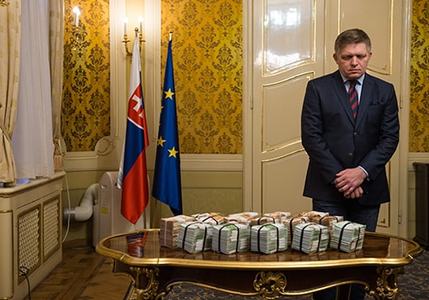
The killings forced then prime minister Robert Fico to resign but he remains leader of the populist-left Smer-SD and is a close ally of the current premier.
Five people have been charged, including a millionaire businessman with alleged Smer-SD ties who is suspected of ordering the murders.
The European Parliament has urged Slovakia to look into “any possible political links to the crimes”.
MEPs voiced “concern about the allegations of corruption, conflicts of interest, impunity and revolving doors in Slovakia’s circles of power.”
Speaking on the campaign trail, Caputova said she would “initiate systematic changes that would deprive prosecutors and the police of political influence”.
In addition to fighting for justice for all, Caputova has promised better care for the elderly and environmental protection.
Earlier this week, she won an endorsement from Jozef Kuciak, the slain journalist’s brother, who denounced Sefcovic for his ties to the political establishment.
“I will not vote for someone supported by oligarchs and their people who have deprived me of my brother and sister-in-law,” he said.
Observers have compared Caputova to French President Emmanuel Macron, an outsider who swept to power on a reformist agenda.
“A similar story unfolded during the last presidential election in France, where the representative of the new political trend and a new political movement prevailed,” analyst Aneta Vilagi said.
But analyst Juraj Marusiak cautioned that both “their programmes were formulated within vague contours, so they can also bring great disappointment”.
“Caputova, like Macron, is a symbol of a very hazily defined hope.”
Published in Dawn, April 1st, 2019