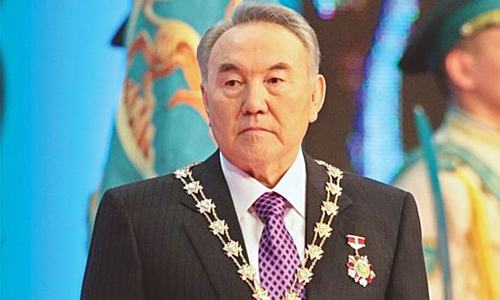
ASTANA: Kazakhstan President Nursultan Nazarbayev shocked the nation on Tuesday by announcing his resignation after nearly 30 years in power.
The Central Asian strongman, 78, had ruled Kazakhstan since before the collapse of the Soviet Union and leaves no obvious successor.
His announcement came a year ahead of the country’s next scheduled presidential election and amid growing frustration over falling living standards.
In a broadcast address to the nation, Nazarbayev said he had decided to step down and that the chairman of the Kazakh senate would take over. “I have taken the decision to resign from the post of presidency,” Nazarbayev said.
“The mandate of the presidency will pass to the chairman of the senate for the remainder of my presidential term.” The senate chair position is currently held by Nazarbayev loyalist Kassym-Jomart Tokayev, 65, a former prime minister and career diplomat.
The announcement came less than a month after Nazarbayev sacked his government, citing a lack of economic development despite the country’s vast energy resources.
That decision followed rising dissatisfaction in Kazakhstan, whose commodity-dependent economy has struggled to recover from a 2014 plunge in oil prices and Western sanctions against Russia, a key trading partner.
Key posts
Nazarbayev will continue to enjoy significant policy-making powers following his resignation thanks to his constitutional status as “Leader of the Nation”.
He became lifelong head of the country’s security council last year.
Nazarbayev won a 2015 election with almost 98 per cent of the vote and had been widely expected to seek another term in 2020.
Under Nazarbayev, the sprawling nation of 18 million parlayed its energy resources and strategic location into influence, emerging from ex-Soviet obscurity to host Iranian nuclear talks and Syria peace negotiations.
The gleaming futuristic new capital Astana, built in the years since independence, symbolised Nazarbayev’s drive to put the country on the map.
Nazarbayev was born to a peasant family and trained as an engineer before rising through the ranks of the Kazakh Communist Party to head it in 1989. He was elected president on the eve of the Soviet breakup in 1991.
Since then, his power has become absolute, with resounding, but internationally criticised election victories in 1999, 2005, 2011 and 2015. There is no obvious succession plan in place and there are no clear alternatives to Nazarbayev’s rule in the largely Muslim country, which has a significant ethnic Russian minority.
Published in Dawn, March 20th, 2019