British lawmakers reject no-deal Brexit

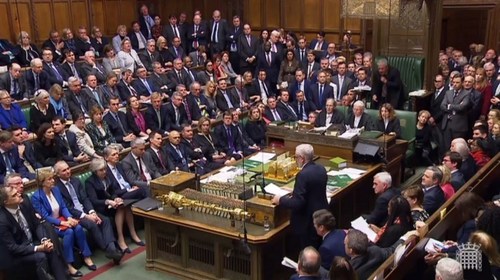
LONDON: British lawmakers overwhelmingly rejected leaving the European Union without a deal on Wednesday, paving the way for a vote to delay Brexit to seek a way out of Britain’s worst political crisis in generations.
Lawmakers voted by 312 to 308 in favour of a cross-party motion that ruled out a potentially disorderly `no-deal’ Brexit under any circumstances.
It went further than the government’s own planned motion, which noted that parliament did not want to leave without a deal on March 29 and that the default legal position was to leave without a deal unless one was ratified by parliament.
While the approved motion has no legal force and ultimately may not prevent a no-deal exit after a possible delay, it carries considerable political force.
After two-and-a-half years of negotiations and two failed attempts to pass a Brexit deal proposed by Prime Minister Theresa May, the vote against a no-deal exit still leaves undecided how, when and on what terms Britain will leave the club it joined in 1973.
After lawmakers crushed her deal for a second time on Tuesday, May said it was still the best option for leaving in an orderly fashion.
Ahead of Wednesday’s vote, the pound headed for its biggest daily rise this year as investors bet on a vote against a no-deal Brexit. It rose again on the result of the vote.
As the United Kingdom’s three-year Brexit crisis spins towards its finale, diplomats and investors see four main options: a delay, May’s deal passing at the last minute, an accidental no-deal exit or another referendum.
DELAY UNTIL WHEN?
If Britain does seek a delay, it will require the agreement of all the bloc’s other 27 members.
The EU would prefer only a short extension, with the deadline of EU-wide parliamentary elections due May 24-26, although it is unclear that this would be long enough to solve the impasse in London.
The EU Brexit negotiator Michel Barnier said the bloc would need to know why Britain wanted to extend talks and that it was up to London to find a way out of the deadlock. The EU said there could be no more negotiations on the divorce terms.
If MPs vote to delay Brexit on Thursday, EU leaders have said they will consider the idea, but they must unanimously agree.
Barnier warned it was now for Britain to set out what it wants to do. “It’s the question that must be answered even before any decision on an extension,” he said.
A group of MPs in May’s Conservative party have put forward an alternative proposal to delay Brexit until May 22 and strike a series of interim agreements with the EU lasting until 2021.
The prime minister said on Tuesday this was not realistic, noting the EU has repeatedly said its deal is the only one on the table.
As Brexit uncertainty spilled into financial markets across the world, investment banks such as Goldman Sachs and JPMorgan are offering different probabilities on the outcome.
“We continue to see a 55 percent chance that a close variant of the prime minister’s Brexit deal is eventually ratified, after a three-month extension of Article 50,” Goldman said. It gave a reversal of Brexit a 35 percent probability and a no-deal Brexit 10 percent.
Catherine McGuinness, policy chief for the City of London financial district, said British business was now “staring down the precipice”. “Politicians of every hue must overcome their differences and make avoiding a no-deal Brexit the absolute priority,” she said.
Carolyn Fairbairn, director-general of Britain’s biggest employers’ organisation, the Confederation of British Industry, said: “It’s time for parliament to stop this circus”. “A new approach is needed by all parties. Jobs and livelihoods depend on it. Extending Article 50 to close the door on a March no-deal is now urgent.”
Britons voted by 52-48 percent in 2016 to leave the bloc, a decision that has split the main political parties and exposed deep rift in British society.
Theresa May’s deal covers such things as citizens’ rights, the status of the Irish border and Britain’s divorce bill from the EU. It takes Britain out of the EU single market and customs union, common fisheries and farm policies and the jurisdiction of the European Court of Justice. It also offers a status-quo transition period in which to negotiate trade arrangements.
Published in Dawn, March 14th, 2019