ISLAMABAD: The country’s inflation widened to 8.2 per cent year-on-year in February, influenced by faster rupee depreciation and demand pressure, according to data released by the Pakistan Bureau of Statistics (PBS) on Friday.
As a result, inflation has crossed the four-year high of 6.78pc recorded in October last year — the period when global oil prices started increasing, undermining earlier gains. The inflation resurged over the past couple of months owing to an increase in prices of fresh vegetables and fruits in major urban centres. The average inflation during the July-February period rose by 6.46pc on a yearly basis.
Take a look: Feeble rupee, IMF and rising inflation
The government has projected 6pc annual inflation for the fiscal year 2018-19, but this figure has already crossed in February this year. The average inflation was 3.92pc in FY18 and 4.16pc the year before.
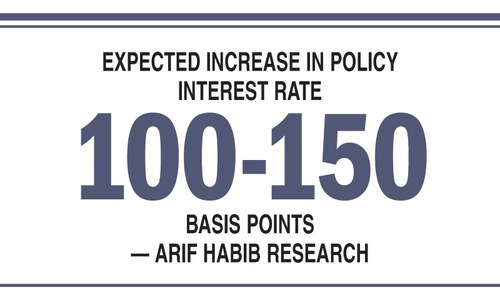
Tightening of the monetary policy by the State Bank of Pakistan (SBP) has come on the back of the rising inflation amid depreciating rupee and high global crude prices over the past two years. Policy rates are already at their six-year high after the SBP raised the key rate by 25 basis points to 10.25pc on Jan 31 this year. The central bank has raised the interest rate by 4.50pc since January last year.
The most dominating push to inflation came from non-food-non-energy (core inflation) component which typically represents the underlying demand pressures on the economy. The core inflation, measured by excluding volatile food and energy prices, was recorded at 8.8pc year-on-year. It has been steadily rising for a couple of months despite tightening of the monetary policy.

The gradual build-up of domestic demand is evident from the upswing in the core inflation. Of the 89 commodity groups of CPI (Consumer Price Index), it covers the price movement of 43 items.
In February this year, food inflation increased by 4.5pc on an annual basis. Prices of non-perishable food items were up by 0.35pc, while those of perishable products fell by 10.4pc. The food items whose prices increased the most in February included tomato (150.04pc), chilly green (37.43pc), pomegranate (11.24pc), chicken (4.17pc), fish (2.02pc), wheat (1.43pc), mutton (0.72pc), pulse masoor (0.60pc) and beef (0.57pc).
The State Bank had in its last quarterly report also mentioned that prices of major items such as wheat and sugar recovered from their depressed levels that had persisted throughout FY18. This recovery has come at a fiscal cost as subsidy-led exports played an important role in offloading surpluses.
Furthermore, the impact of fuel prices was also felt on most food items, as retailers passed on the impact of higher transportation cost to consumers. This impact was more pronounced in the case of milk, vegetables and meat.
On the other hand, non-food inflation went up 10.1pc on a yearly basis. This clearly shows that the direct impact of fuel prices on inflation was also strong.
Prices of non-food items also remained under pressure on account of 11.61pc rise in education index, followed by 6.95pc increase in clothing and footwear and 8.54pc in housing, water, electricity, gas and other fuels during the period under review.
The PBS collects retail prices and computes CPI for a basket of 487 items collected from 40 cities and 76 markets.
Published in Dawn, March 2nd, 2019