US calls for Russian, Chinese nuclear transparency


The United States called for more transparency on Wednesday as it accused Russia and China of not fully reporting their nuclear programmes amid US threats to withdraw from a key arms control treaty.
A senior US official made the remarks as the five permanent members of the UN Security Council ─ all of them nuclear-armed powers ─ met in Beijing for talks on nuclear disarmament and non-proliferation.
Andrea Thompson, US under secretary for arms control and international security, said there were "uneven results" in efforts to advance transparency under the nuclear non-proliferation treaty.
"We previously agreed to set (a) format for reporting, but the gap between the reports of the United States on the one hand, and Russia and China on the other, is great," Thompson said in her opening remarks.
"I cannot overemphasise the value of transparency," she said.
"We look forward to discussing how we can enhance transparency with a view to reassuring others of the very real steps we are taking to ensure full and verifiable compliance with our arms control non-proliferation and disarmament commitments and obligations."
Officials from Russia, China, France and Britain ─ countries under the Non-Proliferation of Nuclear Weapons (NPT) treaty ─ also attended the meeting, which will continue on Thursday.
The talks come after months of raging tensions between Moscow and Washington over the fate of the Intermediate-Range Nuclear Forces treaty (INF) signed in 1987 by then US president Ronald Reagan and Soviet leader Mikhail Gorbachev.
US President Donald Trump has promised to walk away from the agreement while President Vladimir Putin has threatened a new arms race, saying Europe would be its main victim.
Earlier this month, talks in Geneva between senior diplomats from both countries fell through as Washington and Moscow blamed each other for pushing the INF treaty to the brink of collapse.
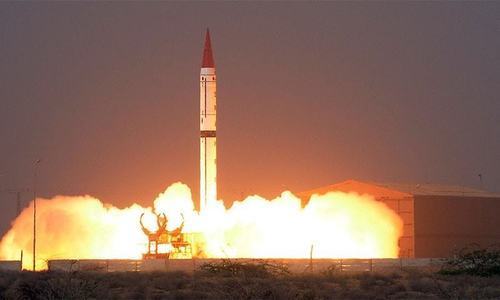
Last week, Russia unveiled its missile system in a bid to reassure foreign officials that its weapon was in compliance with the INF treaty.
But Washington has said the missile system should be destroyed in a verifiable manner if Moscow wants to keep the INF alive.
At Wednesday's conference in Beijing, deputy Russian foreign minister Sergey Ryabkov pointed at "the spread of unilateral attitudes" as a threat to nuclear non-proliferation.
"Many issues continue to be unsettled due to the lack of political will," he added, and said that there is an "evident lack of mutual trust" between the five NPT states.
"This (NPT) regime is being loosened, which is fraught with serious and negative impacts for nuclear non-proliferation," he said.