CARACAS: Venezuela’s powerful military high command threw its weight behind President Nicolas Maduro on Thursday as opposition leader Juan Guaido pressed a direct challenge to his authority with the backing of the United States and key Latin American allies.
Defence Minister Vladimir Padrino, a general, accused Guaido of attempting a “coup d’etat” and said Maduro, 56, is “the legitimate president”. Eight generals who command of strategic regions of the country reiterated their “absolute loyalty and subordination” to the socialist leader in messages carried on state television.
Maduro was re-elected in May in snap elections boycotted by the opposition and denounced around the world as fraudulent. He has held onto power in the face of mass protests, international pressure and opposition efforts to oust him.
Crucially, he has consistently retained the support of the military high command.
In Washington, US Secretary of State Mike Pompeo warned the Maduro government against the use of force against demonstrators in a speech to the Organisation of American States. “The time for debate is done. The regime of former president Nicolas Maduro is illegitimate,” Pompeo said.
Guaido set the showdown in motion on Wednesday by proclaiming himself “acting president” and was swiftly recognised by the US and about a dozen regional governments, including those of Brazil, Argentina and Colombia.
Mexico, Cuba and Bolivia, all in the hands of leftist governments, pledged support for Maduro.
Further afield, Maduro received support from allies Russia and China while France and Canada backed Guaido.
Guaido’s bold move came amid a fresh wave of deadly street clashes between protesters and security forces in this oil-rich but economically devastated country.
A deep depression marked by hyperinflation and shortages of food and medicine has triggered an exodus of Venezuelans to surrounding countries.
Tens of thousands of Venezuelans took to the streets on Wednesday — on the 61st anniversary of the fall of the Marcos Perez Jimenez dictatorship — in rival rallies opposing and supporting the regime.
It capped three days of high tension that began on Monday when a group of soldiers took over a command post in the capital Caracas and rose up against Maduro.
That was quickly quashed and officials said 27 people were arrested but it sparked a wave of smaller protests that were met by security forces using tear gas and rubber bullets.
The Venezuelan Observatory of Social Conflict said that 16 people have died in clashes over the past three days.
Trump angers Maduro
US President Donald Trump almost immediately recognised Guaido’s claims to power, declaring Maduro “illegitimate” and the National Assembly “the only legitimate branch of government”. An enraged Maduro responded by breaking off diplomatic ties with the “imperialist” US government, ordering its diplomats to leave within 72 hours.
Defying Maduro, Guaido urged diplomats to stay put, in an open letter to embassies in the country.
The US State Department said that as it no longer recognised Maduro as president, it did not accept his authority to sever ties or declare its diplomats “persona non grata.”
Maduro’s key ally Russia denounced Guaido’s bid as a “usurpation” of power and warned that “this is a direct path to lawlessness and bloodshed”. The Venezuelan president’s main financial backer China said it opposes “interference” in Venezuelan affairs.
UN Secretary General Antonio Guterres, speaking at the World Economic Forum in Davos, appealed for dialogue to keep the crisis from spiralling out of control, warning it could lead “to the kind of conflict that would be a disaster for the people of Venezuela and for the region.”
Analysts at the Eurasia Group consultancy said international recognition of Guaido as Venezuela’s interim president “will further elevate his profile and cement him as the main face of the opposition”.
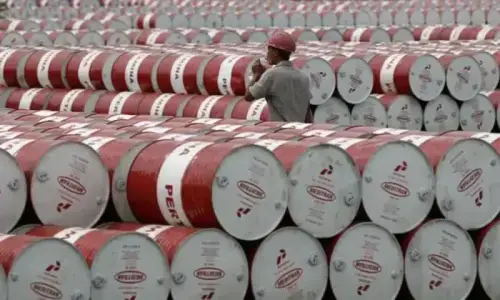
However, Guaido still lacks the “recognition by senior elements of the military” necessary to remove the president and hence “Maduro’s fall does not appear imminent.” They said Trump might consider further economic sanctions against Venezuela, a third of whose oil production goes to the US.
Published in Dawn, January 25th, 2019