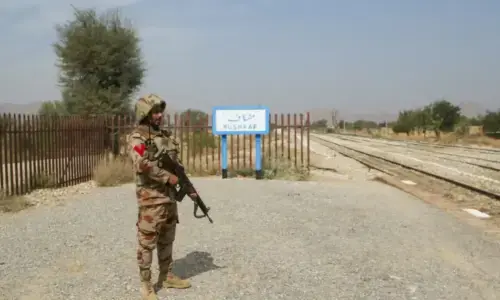
IN November, the Supreme Court passed an order to revive the Karachi Circular Railway which had been lying abandoned since 1999.
The KCR was commissioned for public use in 1964 originating from Karachi City Station up to Drigh Road, stopping at Shahrae Faisal, Liaqatabad, Nazimabad/North Nazimabad, SITE and Wazir Mansion. The loop from Wazir Mansion to the City Station was completed in 1970, thus completing the circle.
Due to a lack of investment, the infrastructure deteriorated and commuters switched to road transport which led to the train operation shutting down in Dec 1999.
In 2004, former Prime Minister Shaukat Aziz formed a task force and asked it to come up with recommendations regarding the KCR. It was eventually decided that the KCR would be revived as a modern commuter system. They committee efurbished the coaches and by March 2005, had commissioned five up and down trains between Karachi city and Landhi, with two trains extended up to Dhabeji.
In order to facilitate commuters and ensure revenue collection, ticketing was outsourced to a private contractor with a fixed revenue return.
The Japanese government also agreed to provide technical and financial assistance for the project. A pre-feasibility study was carried out by the Japan External Trade Organisation. This was completed in March 2006 and was re-validated two years later. The Japan International Cooperation Agency carried out a feasibility study from November 2008 to May 2009, estimating a cost of $1.56 billion. The project was approved by the Executive Committee of the National Economic Council later that year.
A third-party validation of the feasibility study was carried out, and it was updated and approved by ECNEC in August 2012 at an estimated cost of $2.6bn. The cost was estimated on the basis of a Japanese loan at 0.1 per cent mark-up repayable in 40 years.
A resettlement/re-location study of the squatters occupying 20pc of the Right of Way of the KCR was also carried out and was approved by the Environmental Protection Agency and JICA.
In 2016 the KCR was included in the China-Pakistan Economic Corridor projects based on this understanding, the provincial government got PC-1 of the project approved by ECNEC at a cost of $1.97 bn in July 2017.
As per PC-1, the funding from the Chinese will be at a 2.4pc mark-up repayable in 20 years.
I think that in order to get the KCR running, a well-reputed international operator should be engaged to run the circular railway and since the KCR project involves railway land, stations and bridges, the Ministry of Railways should have a lead role in it.
Ishaq Khan Khakwani
Former Minister of State for Railways
Multan
Published in Dawn, December 12th, 2018