

Indian pellet guns in occupied Kashmir kill, blind and enrage
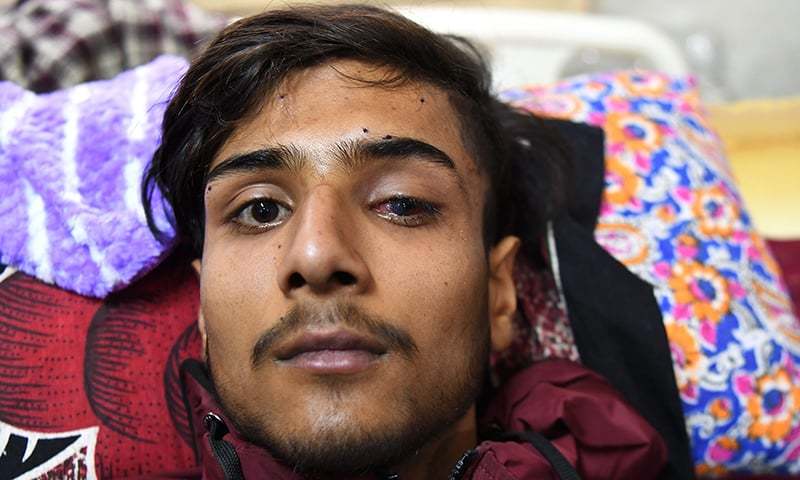

Doctors are fighting to save the right eye of Hiba Jan, the 20-month-old who has become an emblem of India's devastating and highly contentious use of pellet-firing shotguns in occupied Kashmir.
India began deploying the pump-action guns, which spew 600 metal shards at high velocity at a time, in the restive part of Kashmir it occupies in 2010, since then killing dozens and maiming thousands.
As her husband sobbed, Hiba Jan's mother Marsala said that they were shot at trying to escape from clouds of tear gas during disturbances last Sunday.
Indian troops were trying to push back thousands of villagers protesting after the deaths of six Kashmiri fighters and a civilian in a fierce firefight that also killed one soldier.
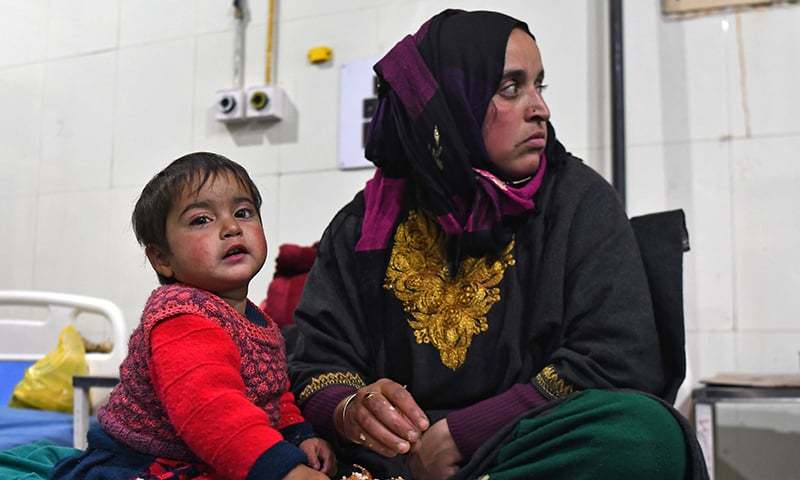
"As soon as I tried to open the metal wire mesh door to get out, a soldier outside fired pellets at us," Marsala told AFP at the SMHS hospital in Srinagar.
"Instinctively, I covered Hiba's eyes with my hand but pellets broke through the net and one lodged in her right eye," she said, sitting in a dark waiting room crowded with other victims.
'Non-lethal'
Violence in occupied Kashmir has so far killed tens of thousands. This year has been the bloodiest in nearly a decade with at least 530 dead so far.
India has about 500,000 soldiers in the part it occupies, where armed groups are fighting for independence or a merger with Pakistan.
India introduced the officially "non-lethal" 12-gauge pellet shotgun in occupied Kashmir in 2010 when major anti-India protests and clashes with government forces left over 100 dead.
Reliable aggregate data about the number of injuries and blindings from the pellets is hard to come by.
Government data from 2017 revealed the weapon killed 13 people and injured more than 6,000 in eight months alone, including nearly 800 with eye injuries.
2016 is still recalled by locals as the year of mass blinding in Kashmir, or as the "dead eye epidemic".
Read: What pellet guns have done to protesters in Kashmir
More than 1,200 victims — men, women and children — have organised themselves as an association since 2017, the Pellet Victims Welfare Trust.
Nearly 100 of them have both eyes severely damaged or are completely blinded.
Its chief, Mohammad Ashraf, blind in one eye and with 635 pellets lodged in his body and head, said they came together after meeting and sharing stories in hospital.
"We were like walking dead, emotionless and purposeless, a burden on our families," Ashraf told AFP. Some of its members report having suicidal feelings.

Lawyers say most of the victims have been booked by police in cases like rioting, stone throwing, damaging public property, or other grave offences.
Many with blinded eyes and other injuries are in jail under a preventive detention law that allows for imprisonment between three months and three years without charge.
"Not a single case has reached the stage of trial," said human rights lawyer Arshid Andrabi.
The local government has paid cash compensation to a handful of victims, but the Trust depends on individual donations and support from numerous mosques in the Muslim-majority territory.
'Lethal at close range'
India's interior minister said in 2016 that the pellet guns are used as a last resort but refused to stop deploying it for crowd control.
The Central Reserve Police Force (CRPF), the Indian paramilitary deployed in Kashmir, told a court in 2016 that they fired about 1.3 million pellets in just 32 days.
Explore: Will the pellet gun victims in Kashmir ever regain their eyesight?
In June this year, a report rejected by India from the UN human rights office called for a major investigation into abuses in occupied Kashmir, highlighting the use of pellet guns as an area of concern.
Amnesty International has urged the Indian government to ban the use of pellet guns, and lawyers and other rights groups have appealed to courts, to little avail so far.
US-based Physicians for Human Rights has called their use "inherently inaccurate (and) indiscriminate", and potentially "lethal to humans at close range".
According to Amnesty International, Israel, Egypt and Venezuela have also used the pump action gun for crowd control but rarely against unarmed protestors.
Egyptian activist Shaimaa al-Sabbagh died after he was hit with pellets in Tahrir Square in 2015. His death led one police officer being sentenced to 15 years in prison.
But there have been no prosecutions of any Indian forces personnel.
On Tuesday, as little Hiba's well-publicised plight added to local anger, the local government ordered an inquiry into the pellet firing incident to "fix responsibility".
"Since 2003, government ordered at least 210 such magisterial enquiries, but not in a single case anyone has been held responsible or punished," a prominent rights lawyers, Pervez Imroz told AFP.




























