0
0

UNITED NATIONS, June 22: Pakistan on Tuesday said that the draft framework resolution circulated by G-4 countries –- Japan, Germany, India and Brazil — was “inequitable and unfair” as it sought the privilege of a permanent presence for six states on the Council, thus reducing the prospects of the other 180 states to serve on the Council.
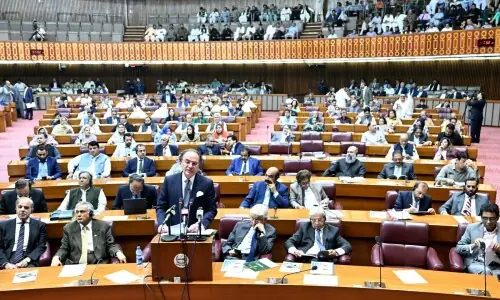
“Some of those excluded have as good if not better credentials to serve on the Council than some of the declared aspirants”, said Pakistan’s UN Ambassador Munir Akram while addressing the General Assembly on Wednesday during its exchange of views on its President’s Draft Outcome Document of the highlevel plenary meeting.
Mr Akram declared that the Security Council reform can only be achieved if the proposed changes enjoy consensus or the widest possible agreement of the general membership.
“Indeed this is the rule we are following for the elaboration of the entire Outcome Document. The differences among the various positions will thus need to be reconciled in order to promote consensus or widest possible agreement”, he said.
Noting that there are several proposals now “on the table”, including G-4 draft resolution and several divergent positions on the issues including that of the United States, and other regional groups, Mr Akram said Pakistan strongly subscribes to the United For Consensus (UFC) proposal of May 27 circulated by the Italian ‘focal point’.
Underscoring that the merits of UfC proposal are numerous ,Mr Akram said: First, it preserves the principle of sovereign equality: The majority of UN member states are not asked to stamp themselves as “second” or “third” class members of the international community;
Second, it is equitable and fair: All member states are eligible for election to all non-permanent seats;
Third, it is representative: It would increase the ratio of permanent to non-permanent members from 1:2 to 1:4 and thus better reflect the composition of the UN’s general membership which includes mostly smaller and medium states (not aspirants for permanent membership);
Fourth, it is flexible: It can accommodate the positions of regional groups. Now that no proposal seeks additional vetoes, the UfC’s approach can accommodate the African desire for continuous representation of certain states. Of course, those seeking election or re-election will have to seek the periodic approval of their peers, which is the essence of democracy and will enhance the accountability of those seeking to represent their regions on the Council;
Fifth, it is simple: It can be directly incorporated in a Charter amendment without going through an uncertain process of a framework resolution, election of new (permanent) members, and then adoption of a Charter amendment.
Rejecting the G-4 proposal Pakistan’s chief delegate pointed out that “the rationale for seeking permanent membership has been eroded by the withdrawal of the unachievable demand for the veto. In any event, the G-4’s three-step process is complicated and will, in all probability, lead to a deadlock and a dead-end for Security Council reform. “
Broadly supporting the United States position on the UN Reforms, Mr Akram however said: “While we question the need for any additional permanent members, we endorse the US view that Security Council reform “should not sprint ahead of other reforms” and that dialogue and consultations on this issue should be continued.”
Expressing hope that a “sense of realism and equity prevails, agreement could be reached sooner rather than later on this difficult issue”, Mr Akram said: “We remain opposed to the imposition of artificial deadlines for a decision and thus to any precipitate vote on any of the proposals.”
He said: “For the September Summit, we should seek to build the widest possible agreement on the common elements that are present in various positions: (i) need for enlargement; (ii) better representation of developing countries; (iii) improving the Council’s working methods, including greater transparency, democracy and accountability. Thereafter, the divergences in positions could be appropriately addressed and overcome.”
DISARMAMENT AND NON-PROLIFERATION: Mr Akram said that the provisions on disarmament and non-proliferation are in our view inadequate. The September Summit should seek to evolve a new consensus on disarmament and non-proliferation. This consensus should incorporate the following: one, disarmament and non-proliferation are two sides of the same coin; two, to achieve both objectives, the underlying security concerns of all states, large and small, must be addressed, in accordance with the principle of “equal security for all states.”
In this context, the growing asymmetry of military power and the frequent use of force need to be addressed both globally and in various regions; three, the threat from WMD is growing. It arises not only from their proliferation but from their very existence. Complete WMD disarmament must remain an important goal. A biological weapons verification mechanism is essential.
The reality of 8, not 5, nuclear weapons states must be accommodated. The NPT regime must adjust to the new realities and challenges if it is to survive. It should seek to halt both vertical and horizontal proliferation; four, international regimes are required to regulate missiles, anti-ballistic missiles and outer space militarization; five, international cooperation must be achieved to prevent the nightmare scenario of WMD falling into the hands of terrorists; six, the most effective approach to disarmament and non-proliferation is international cooperation and open negotiations and free acceptance by states of international agreements, not coercion or the use of force.