Turkey withdraws from Libya summit in Italy


 0
0

ANKARA: Turkey has withdrawn from a two-day summit about Libya that is being held in Italy with “deep disappointment”, Turkish Vice President Fuat Oktay told reporters on Tuesday, objecting to what he said was Ankara’s exclusion from some of the talks.
“Any meeting which excludes Turkey would prove to be counter-productive for the solution of this problem,” Oktay said. Italy’s populist government organised the two-day conference in hopes of making progress on ending Libya’s lawlessness and promoting a UN framework for eventual elections.
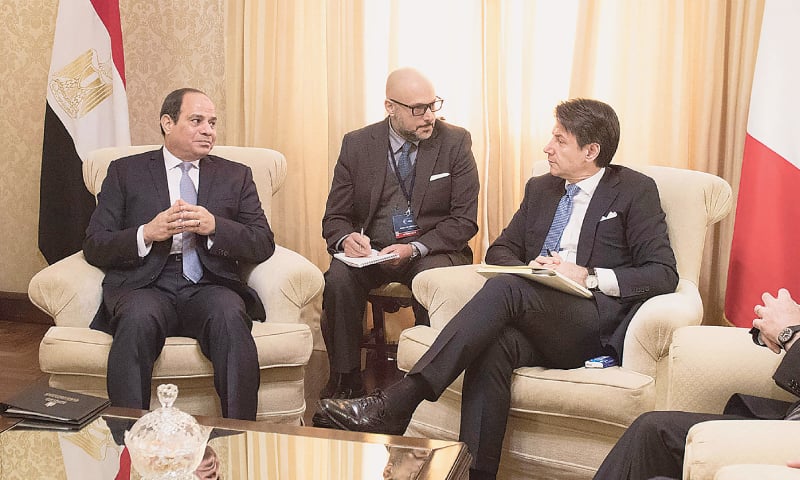
But expectations were limited, with Hiftar’s camp making clear that he wasn’t participating in the conference itself but rather meeting with leaders of neighbouring countries on the sidelines. Neither Hiftar nor el-Sissi posed for the final conference group photo.
And Turkish Vice-President Fuat Oktay pulled out before it ended, citing his exclusion from the morning mini-summit.
“The informal meeting, held this (morning) with a number of players and having them presented as the prominent protagonists of the Mediterranean, is a very misleading and damaging approach which we vehemently oppose,” he told reporters.
“Turkey is leaving the meeting with deep disappointment,” he said.
An Italian diplomatic official, briefing reporters in Palermo, said the atmosphere of the mini-meeting was cordial and collaborative and that Hiftar told Serraj to stay in charge until the elections.
A statement on social media Tuesday by a spokesman for Hiftar’s army, Ahmed al-Mesmari, suggested that Hifter was snubbing the broader conference because he accuses representatives from the Tripoli side of working with militias he considers illegitimate, as well as Islamic extremists backed by Qatar.
In an interview provided by his media office, Hiftar said he wanted to meet with African leaders in particular to discuss migration.
“We are still at war, and the country needs to secure its borders,” Hiftar said.
Libya plunged into chaos after the 2011 uprising that ousted and killed longtime dictator Moammar Qadhafi, and it is now governed by rival administrations in the east and west with both relying on the support of militias.
It has also become a haven for Islamic militants and armed groups, including several from neighboring countries, which survive on looting and human trafficking, particularly in the remote south of the country.
Italy’s anti-migrant government is keen in particular to stem the Libyan-based migrant smuggling networks that have sent hundreds of thousands of would-be refugees to Europe via Italy in recent years.
Published in Dawn, November 14th, 2018