CM directs education dept to upgrade school curriculum

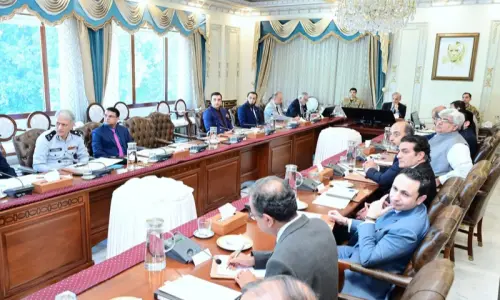
KARACHI: Sindh Chief Minister Syed Murad Ali Shah has directed the education department to upgrade school curriculum and textbooks to align the syllabus with the United Nations Sustainable Development Goals 2030 for which special focus will be given to improvement of science, mathematics and English language textbooks.
Mr Shah, who was presiding over a meeting held here at CM House on Friday to improve school education system, recalled that “we have a very small number of science, maths and English teachers” and highlighted the need for their recruitment through a special recruitment process.
Addressing the meeting, which was attended by Education Minister Syed Sardar Shah, principal secretary to the CM Sajid Jamal Abro, education secretary Qazi Shahid Parvez, MD of Sindh Education Foundation and others, the chief minister said over the last five years the PPP government provided Rs3,500 stipend per child to 340,000 girl students and provided free textbooks and did not charge examination fee from students.
“Over 30,000 teachers have been hired over the past 10 years purely on merit while 957 headmasters were recruited through IBA and 40,000 in-service teachers’ training has been made,” he added.
Mr Shah said heavy investment in school education had been made during the last five years.
Giving details from 2014-15 to 2017-18, he said Rs459 billion was spent.
“We have to make more effective and focused measures to improve our school education,” he said.
He asked the education department to start conducting viability assessment of 15,214 low or zero enrolment schools and 15,000 medium enrolment schools with the objective to rightsize the total number of schools and ensure that financial resources were invested at right place.
He gave approval for high-priority school infrastructure project under which infrastructure of 2,632 schools would be completed by June 2019 in the first phase and in the second 1,928 schools would be rehabilitated.
He also issued directives for increasing access to early childhood care and education.
The chief minister directed the education department to assess the locality, enrolment size, accessibility of shelter-less schools so that appropriate action could be taken.
Earlier, secretary of school education Qazi Shahid Pervaiz briefed the meeting participants about upgrading of 483 schools to middle and high schools, reconstruction of 185 school buildings and providing 214 shelter-less schools with new buildings.
He said three public schools at Ghotki, Tando Adam and Umerkot had been established.
Similarly 4,206 schools were being provided with basic facilities that were missing while 2,632 schools would be made functional by June 30, 2019.
Over six million children out of school
Replying to a question, Education Minister Sardar Shah said 6,413,227 children were out of school in Sindh.
He further elaborated that major problems of dropout of schoolchildren include dearth of post-primary schools, missing facilities in 9,839 schools, 17,701 single schoolteacher schools and 4,910 shelter-less schools.
The chief minister was told that out of 106 “state-of-the-art” schools being constructed under the USAID-funded Sindh Basic Education Programme, 43 schools were constructed and 20 of them had been handed over to operate them on public-private partnership mode while 45 primary/middle schools were constructed with the assistance of Japan International Cooperation Agency in remote areas of the province.
Published in Dawn, November 3rd, 2018