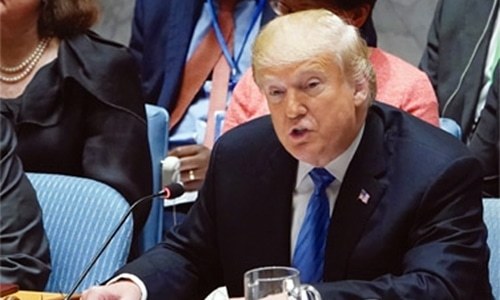
The European Commission on Monday urged the United States and Russia to pursue talks to preserve a nuclear weapons treaty after President Donald Trump said Washington was withdrawing from the deal.
The Commission, the 28-nation European Union executive, stressed the Intermediate-Range Nuclear Forces Treaty (INF) has been a mainstay of European defence for the last three decades.
“The US and the Russian federation need to remain in a constructive dialogue to preserve this treaty and ensure it is fully and verifiably implemented,” spokeswoman Maja Kocijancic told reporters.
She said the agreement was important for both European and global security.
“The treaty for Intermediate-Range Forces in Europe contributed to the end of the Cold War, to the end of the nuclear arms race and is one of the cornerstones of European security architecture since it entered force 30 years ago,” she added.
“And thanks to this treaty almost 3,000 missiles with nuclear and conventional warheads have been removed and verifiably destroyed,” Kocijancic said.
“It is also an important contribution to disarmament obligations under the Nuclear Non-Proliferation Treaty,” she said.
The agreement banning intermediate-range nuclear and conventional missiles was signed in 1987 by then US president Ronald Reagan and Mikhail Gorbachev, the last Soviet leader.
Gorbachev on Sunday said that “dropping these agreements... shows a lack of wisdom” and was a “mistake”.
The Trump administration has complained of Moscow's deployment of Novator 9M729 missiles, which Washington says fall under the treaty's ban on missiles that can travel distances of between 310 and 3,400 miles (500 and 5,500 kilometres).
The Brussels-based North Atlantic Treaty Organization, which includes the United States, has long echoed those concerns, including during a meeting of its 29 defence ministers this month.
“After years of denials and obfuscation, Russia recently acknowledged the existence of the (9M729) missile system without providing the necessary transparency and explanation,” NATO spokeswoman Oana Lungescu told AFP.
“In the absence of any credible answer from Russia on this new missile, Allies believe that the most plausible assessment would be that Russia is in violation of the INF Treaty. Allies continue consultations,” she said.
When asked if the EU shares the US position that Russia should be blamed for the treaty's lapse, Kocijancic renewed the call for dialogue.
“We of course expect the Russian federation to address the concerns regarding its compliance with the treaty in a substantial and transparent way,” the commission spokeswoman said.