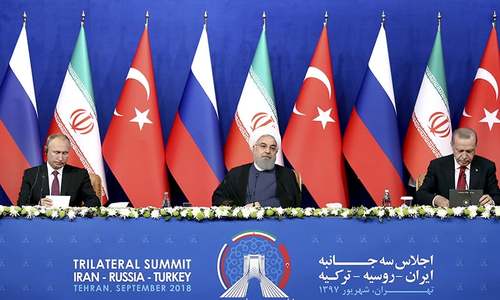
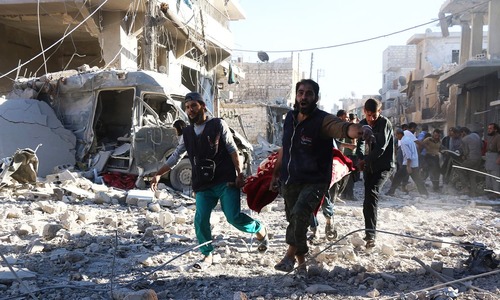
TEHRAN: The presidents of Turkey, Iran and Russia on Friday failed to agree on a ceasefire that would forestall a Syrian government offensive in rebel-held Idlib province which the United Nations fears could cause a humanitarian catastrophe involving tens of thousands of civilians.
Turkey’s Tayyip Erdogan, Russia’s Vladimir Putin and Iran’s Hassan Rouhani, meeting in Tehran for a summit of key foreign players in Syria’s war, agreed in a final statement that there could be no military solution to the conflict and it could only end through a negotiated political process.
But as Syrian government and Russian warplanes mounted air strikes in Idlib on Friday morning in a possible prelude to a full-scale offensive, Putin and Rouhani pushed back against Erdogan’s call for a truce.
The Turkish leader said he feared a massacre and Turkey could not accommodate any more refugees flooding over its border.
Putin said a ceasefire would be pointless as it would not involve Islamist militant groups it deems terrorists. Rouhani said Syria must regain control over all its territory.
Idlib is the insurgents’ only remaining major stronghold and a government offensive could be the war’s last decisive battle.
Tehran and Moscow have helped Assad turn the course of the war against an array of opponents ranging from Western-backed rebels to the Islamist militants, while Turkey is a leading opposition supporter and has troops in the country.
Their discussions in Tehran mark a crucial point in a seven-year-old war which has killed more than half a million people and forced 11 million to flee their homes.
Erdogan, in his opening remarks, said a ceasefire in Idlib would be a victory for their summit.
Putin responded: “The fact is that there are no representatives of the armed opposition here around this table. And more still, there are no representatives of Jabhat al-Nusra or ISIS or the Syrian army.”
“I think in general the Turkish president is right. It would be good. But I can’t speak for them, and even more so can’t talk for terrorists from Jabhat al-Nusra or ISIS that they will stop shooting or stop using drones with bombs.” In the final statement, the three agreed on the need to eliminate the militant Islamic State group, the Nusra Front, and other groups linked to Al Qaeda and designated as terrorists. But there were were other armed opposition groups who could join any ceasefire agreement, they said.
The communique also called on the United Nations and the international community to step up humanitarian aid to Syria and help in restoring basic infrastructure assets.
Efforts must be made to protect and to create conditions for the safe return of refugees, it added.
Iran’s Rouhani said the battle in Syria would continue until rebels were pushed out of the whole country, especially in Idlib, but he added that any military operations should avoid hurting civilians. He called on all rebels in Syria to disarm and seek a peaceful end to the conflict.
“The fight against terrorism in Idlib is an indispensable part of the mission to return peace and stability to Syria, but this fight should not harm civilians and lead to a “scorched-earth” policy,” Rouhani said.
Erdogan said Turkey no longer had the capacity to take in any more refugees from Syria should the government offensive in Idlib go ahead. Turkey has accepted 3.5 million refugees from Syria since the start of the war in 2011.
“Whatever reason there is an attack that has been made or will be made will result in disaster, massacre and humanitarian drama,” he said. “Millions will be coming to Turkey’s borders because they have nowhere to go. Turkey has filled its capacity to host refugees.”
The Assad government was not directly represented at the summit, nor were the United States and other Western powers.
Published in Dawn, September 8th, 2018