RAWALPINDI: Prime Minister Imran Khan, speaking at the main Defence Day ceremony held near the Martyrs’ Monument on the lawns of GHQ on Thursday, rejected the perception of civil-military imbalance in the country as a myth and said both sides were united to make the country great once again.
“A myth of civil-military imbalance has been created. It looks as if some huge confrontation is going on. (But) there is no such thing. All of us have a common goal of making the country rise.”
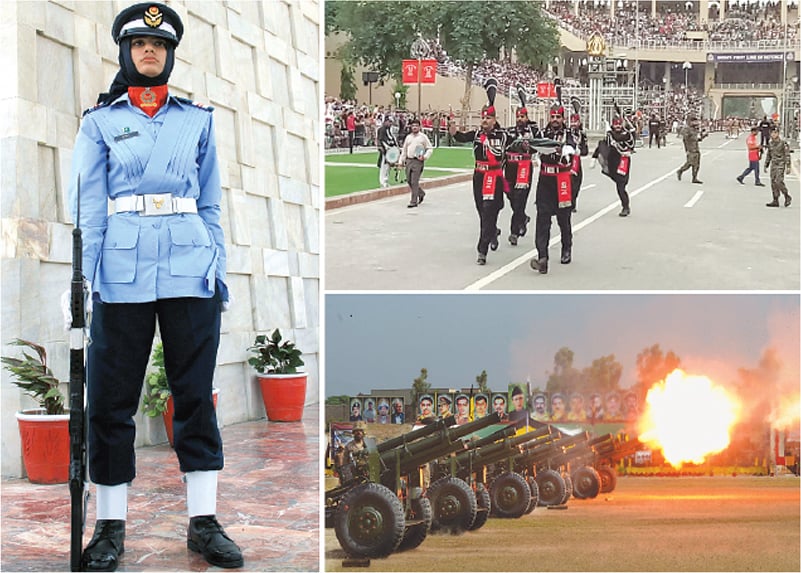
It is unprecedented, at least in recent times, for an elected prime minister to speak at an annual Defence Day ceremony at the military headquarters, where the Army Chief has always been the main speaker. The ceremony is held to commemorate Pakistan’s successful defence against Indian aggression in 1965. Since 2014 the ceremony also remembers those martyred in the fight against terrorism in which nearly 70,000 people, including thousands of troops and law enforcement agencies’ personnel, have lost their lives.
The talk of civil-military imbalance in which the military is accused of not giving civilians a free hand to run government affairs — particularly in the key domains of foreign policy, security and national defence — is an old one. However, the debate has turned nastier over the past few years when the ties of then ruling party — Pakistan Muslim League-Nawaz — with the military leadership became strained.
Describes armed forces as only functional institution in country; COAS says continuity of democracy is essential for national integrity, unity and development
The optics changed after Imran Khan assumed the prime minister’s office. Last week, he visited GHQ for a security briefing where he was warmly welcomed by the military leadership with Army Chief Gen Qamar Bajwa going to the extent of thanking him for reposing confidence in the Army.

The prime minister praised the armed forces as the only functional institution in the country. He said it happened because professionalism and merit was followed there and it had remained safe from political interference. “Institutions are destroyed because of political interference and ignoring merit,” he underscored and said that wars “cannot destroy a country, but lack of justice and merit can do that”.
“I’ll try to bring meritocracy and strengthen institutions,” he said.
The newly elected prime minister mentioned water, energy and debt burden as the key challenges facing the country. Assuring the audience that Pakistan was “destined to rise as a strong and united nation and again attain greatness”, he, however, said that for that to happen the commoners needed to be made stakeholders in the national affairs by making their future secure, assuring justice, guaranteeing protection, and observing merit. He warned that countries where few were privileged did not become great nations.
Touching upon foreign policy, Mr Khan, who the other day had held some intense talks with a US delegation led by Secretary of State Mike Pompeo, said only a foreign policy that served the country’s interest would be followed.
He said he too had remained opposed to the “war on terror” and would like to reassure his countrymen that Pakistan would not fight others’ wars.
Published in Dawn, September 7th, 2018