In his poem ‘Fancy’, John Keats explores the ceaseless and enchanting possibilities of letting one’s imagination run wild. In a show at Karachi’s Chawkandi Art Gallery, artist-cum-curator, Dua Abbas Rizvi adopted similar ideas and took the show’s title straight from Keats’s work. Ever Let the Fancy Roam was exhibited and featured new works of five artists — Mohsin Shafi, Maria Khan, Sara Khan, Suleman Khilji and Haya Zaidi.
The exhibition is an exploration of the imaginative world of folktales. These tales are universal and their essence is passed on from one generation to the next, from one region to the other. Their commonalities prove that they are reflections of the human psyche; of dreams, fears and desires. Everyone has read them or at least experienced adaptations of these narratives in literature, art and films. Folklorists realised that all these tales could be categorised into five classes as per their theme and literary structure. In turn, Abbas appointed each with a story fitting a specific class and belonging to a specific region.
Zaidi was given the Russian tale of ‘The Mistress of the Copper Mountain’, the story of a beautiful woman who blessed the locals that followed her rules with good luck. The artist adapted the story to feminist concerns addressing her work, and examined the relation between the notion of evil and empowered women. Sticking true to her unique medley of mixed media, Zaidi produced art that focused on the female form. Each piece highlights a trait of an empowered woman, like the importance of loving herself in the paintings ‘Self-indulgence’ and ‘Flesh’. Each piece shares similar background as well as elements from human anatomy diagrams.
An exhibition explores the imaginative world of enchanting folktales
The absurd Egyptian tale of ‘The Falcon’s Daughter’ was expressed through the multifaceted paintings of Sara Khan. The story was brought forth through her whimsical interpretation of the Falcon’s daughter and parents. The story takes a dark turn, bridled with deception, mutilation, incest and death before finally reaching a happily-ever-after ending. Sara Khan paints the expecting father, suffering from pangs of pregnancy after eating the pomegranate his wife warned him about. The mother is portrayed with a diagrammatic uterus for a head, placed on a delicate physique against a soft pink background. The daughter is represented till midriff, with a strange face and talon-like hands. Her body is divided with fauna, feathers and other motifs possibly describing her journey from being raised by a bird to becoming a princess. Khan’s inimitable style creates an air of mystique and cloaks the dark narrative with whimsy and colour — which is what fairytales do.

Abbas explains that the empathy brought out by Maria Khan and Suleman Khilji made them imperative additions to the show. Maria Khan portrays an Italian story of a young girl who turns her luck around by being thoughtful and patient. Khilji is given a Japanese tale, which recounts the story of a hopeful man who follows through a preposterous task despite deception and ridicule.
Both tales illustrate underdogs striving for greatness, giving one hope for the possibility of a better tomorrow. Khilji creates a parallel aura around his male characters through his soft colour palette and dreamlike backgrounds. Maria Khan’s work, though darker, brings forth the suppleness of the form as the figure exposes herself to the audience. The fastidiousness of the contours exemplifies the vulnerability of the woman’s expression and increases empathy for the character.

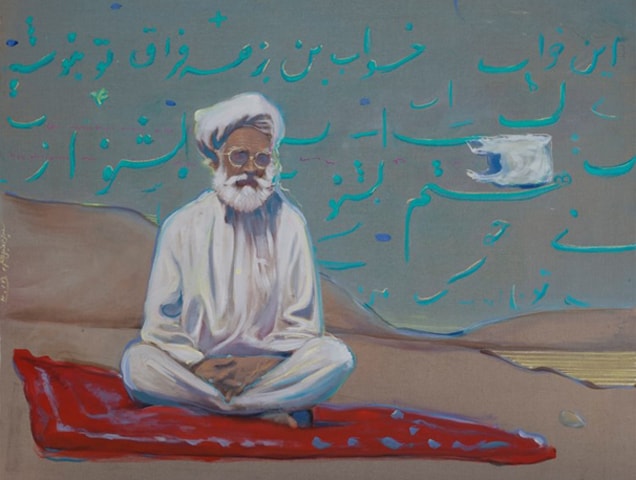
Shafi’s recurring socio-political statements warranted him the Indian story, ‘The King of Cheats.’ A tale of two men outwitting each other is depicted through four collaged artworks. Shafi’s delicately crafted works weave together several histories and intermingle each tale giving us illustrations of history repeating itself, cultures sharing the same basic problems and, most importantly, how universally identifiable these fantastical tales can be.

“Ever Let the Fancy Roam” was displayed at the Chawkandi Art Gallery, Karachi from August 7 to August 15, 2018
Published in Dawn, EOS, September 9th, 2018