2
2

ISLAMABAD: A representative of the United Nations Population Fund (UNFPA) on Tuesday said 2.2 million abortions were carried out in Pakistan every year which clearly showed that there was an unmet demand for contraceptives in the country.
“Imagine how difficult it would be for a woman in Pakistan to go for an abortion. It shows that she did not want pregnancy but we failed to provide her the contraceptive. It is not acceptable at all and we need to do something to avoid such pregnancies,” Dr Hassan Mohtashami said at the launch of Pakistan Demographic and Health Survey (PDHS) in a local hotel. The survey was conducted by the National Institute of Population Studies (NIPS).
Dr Mohtashami said though Pakistan may not achieve the commitment of family planning by 2020 it was not about an international commitment rather about the health of women.
“The new government has shown priority for child and maternal care. I suggest that the government should go for family planning because it is simple that fewer pregnancies will reduce the chances of mortality,” he said.
UN official stresses importance of family planning saying fewer pregnancies will reduce chances of mortality
However, he said, immunisation rate in the country had increased to 66pc which was a good progress.
NIPS Executive Director Pervaiz Ahmed Junejo said maternal mortality ratio (MMR) was not included in the survey because of lack of resources.
“However, it has been decided to hold a separate survey on MMR which would be linked with the PDHS. Moreover, some of the clusters which were included in the survey could not be covered because of security issues as we did not want to risk the safety of our staff/teams. Most of the clusters were in Balochistan but a few were in other parts of the country,” he said.
NIPS Deputy Project Director Dr Aysha Sheraz said 580 clusters, which had approximately 16,240 households, were selected for the survey across the country.
“But the survey could not be held in 19 clusters because of security and weather conditions. It was a huge success because the survey was completed despite a number of challenges.”
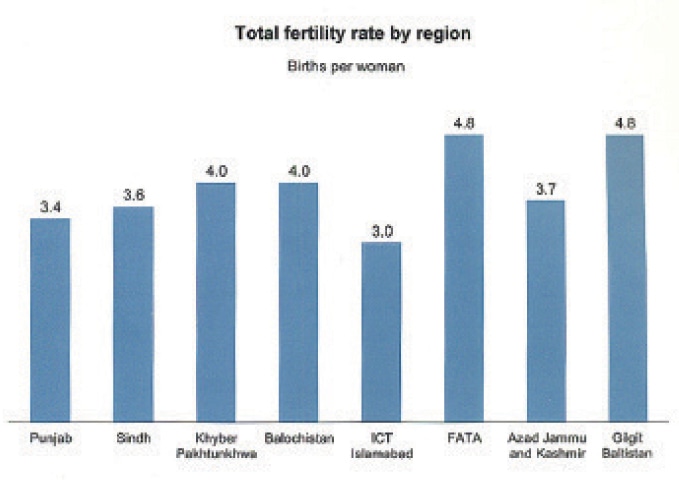
She said as per findings of the survey, on an average each woman in the country gave birth to 3.6 children. The ratio is 2.9 per woman in urban areas and 3.9 children per woman in rural areas.
There was a visible decline in the birth rate as it was 5.4 children per woman in 1990. The birth rate is the minimum in Islamabad and maximum in Gilgit-Baltistan, she said.
Dr Sheraz said the survey also showed that 26pc women wanted the next child within two years and 16pc after two years. She said 47pc women did not want more children and the remaining were undecided.
“As many as 34pc women were using any kind of contraceptives. The use of modern contraceptives was highest in Islamabad and lowest in Balochistan. The trend of unmet need for family planning has decreased from 31pc (in 1990) to 17pc. Under-five mortality rate is 74 per 1,000 children and the infant mortality rate is 62 per 1,000 live births. Around 66pc children received all vaccines and only four per cent did not get any vaccine.”
She said 38pc children were found stunted in the country while the percentage was 24 in Islamabad.
Published in Dawn, August 29th, 2018