0
0

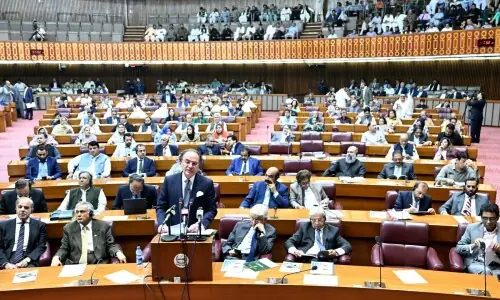
ISLAMABAD, June 9: Opposition leaders came down hard on the government on Thursday as the National Assembly began its general debate on the national budget for fiscal year 2005-06 that they said had a lot for the rich and little for the poor.
The main attack against the government’s fiscal, domestic and foreign policies came from opposition leader Maulana Fazlur Rehman, People’s Party Parliamentarians president Makhdoom Amin Fahim and Pakistan Muslim League (Nawaz) parliamentary leader Nisar Ali Khan.
Defence of the budget from treasury benches was led by Minister of State for Railways Ishaq Khan Khakwani, who dismissed the opposition attacks as “criticism for the sake of criticism” and credited the government with pursuing an all-round development and making much better use of national resources than the parties now in opposition.
Prime Minister Shaukat Aziz briefly attended both the morning and evening sittings of the assembly in what seemed to be a move to have a feel of the opposition’s criticism and quash already denied rumours of Wednesday that he had resigned.
Opposition leaders used the occasion to attack the country’s military presidency that they saw as a hurdle in the way of a democratic transition, lack of law and order and what they called foreign-dictated foreign and economic policies.
They described the salary and pension increases of 10 and 15 per cent, respectively, for government employees as insufficient and took the government to task for not being able to announce the National Finance Commission award for the third year.
Fazlur Rehman, who opened the debate, said International Monetary Fund experts were still dictating the country’s budget-making despite the government’s claim of breaking the begging bowl by ending dependence on IMF loans.
He said the government continued to be dependent on loans and privatization revenues and feared mini-budgets would follow, particularly after the promised announcement of the NFC award by President Pervez Musharraf after two to three months.
He credited the 8.4 per cent Gross Domestic Product growth in 2004-05 mainly to good weather for agriculture rather than any government policy and said he feared the growth would fall if weather was not as good next year.
He said the federal government had gained Rs200 billion to Rs300 billion by not announcing a new NFC award for three years and accused Minister of State for Finance Umar Ayub Khan of being instrumental in the same thing being done to the smaller provinces that his grandfather, former president Mohammad Ayub Khan, had done to former East Pakistan.
The opposition leader accused the government of following a pro-America foreign policy, reneging on the country’s traditional stand on the Kashmir dispute and being responsible for what he saw as reservations of traditional friends like China and Iran and new ally Afghanistan.
He said the country’s success depended on following the lines delineated by the 1973 Constitution, including the Islamic ideology, a parliamentary democracy and provincial autonomy, all of which, he said, were being negated by President Musharraf.
Amin Fahim said most relief in “the budget of the rich” had gone to the “already established” classes such as industrialists and traders while there was little comfort for the poor, many of whom committed suicides for being jobless.
He described increases in pays and pensions of government employees and fixation of the minimum wage at Rs3,000 as a mere drop in the bucket and suggested that the assembly call a clerk and hear how a petty employee could support a usual family of five. “Poor people cannot survive under this budget,” he said.
Mr Fahim opposed privatization of profit-making enterprizes such as the Pakistan Telecommunication Company and praised the utility’s workers for blocking its sale.
He opposed increase in allocations for the presidency, complained of law and order situation in Sindh, accused the government of turning the country into a police state and said he feared it would rig the local bodies elections through administrators who would replace nazims.
Mr Khakwani rejected the criticism about the absence of NFC award and said delay for the sake of reaching a consensus among the provinces and their recent move of requesting the president to determine the award should not be made contentious.
He defended the government’s privatization policy and said jobs of all the PTCL employees would be protected in the future arrangement.
The minister drew some opposition heckling after he accused the previous governments of “gulping down” foreign loans and referred to an angioplasty of former senator Asif Ali Zardari in Dubai as an attempt to avoid appearance before a Swiss court.
Nisar Ali Khan did not object to the increase in defence budget but said it should be ensured that earnings from “the people’s sweat and blood” were spent really on national defence rather than for messes, housing societies and big cars.
Referring to the planned purchase of more F-16 jets from the United States, he said such big deals as well as the sources of money for the purchase should be shown in the budget.
He accused the government of failing to consult opposition parties, business organizations and agricultural experts before preparing the budget.
He said the GDP growth would not be sustainable in view of high inflation and energy costs.
The PML-N leader complained that two separate legal systems were in vogue for civilians and the military and while politicians were being humiliated by the National Accountability Bureau, no action was being taken against army officers on charges of corruption.