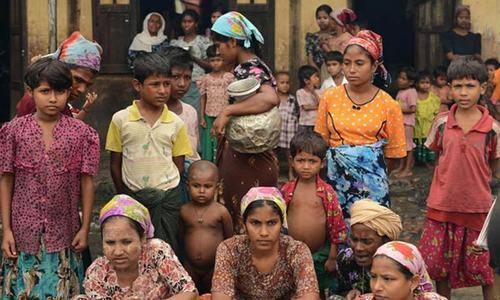
Landslides triggered by monsoon rains killed at least 12 people on Tuesday in Bangladesh near camps housing one million Rohingya refugees, officials said.
Aid agencies have been warning of the potential for a humanitarian catastrophe over the coming months as heavy rains lash an area home to the world's largest refugee camp.
Most of Tuesday's victims were buried under mud when surrounding hills gave way after a deluge.
Eleven people died in Naniarchar including a family of four, while several people remained missing, district administrator Mamunur Rashid told AFP.
Another person was killed in neighbouring Cox's Bazar district, police said.
Landslides have so far killed at least 13 people this week, after a Rohingya boy was crushed to death by a collapsing mud wall at the Kutupalong refugee camp on Monday.
Some 200,000 Rohingya who live on hills around the refugee camps are at risk of death or injury from monsoon rains, officials and relief agencies have said.
Many of the hills around the settlements have been cleared of trees to build shelters, making the land highly unstable.
Nearly 29,000 people have been moved to new locations ahead of the monsoon but the risk of a tragedy remains high.
“Relocation is continuing but the problem is where (to) find land to move people,” UN refugee agency spokesperson Caroline Gluck told AFP.
At least 300 shelters were damaged by rains that began late Saturday, Bangladesh officials said.
The International Federation of Red Cross and Red Crescent Societies (IFRC) said waterborne disease was on the rise as floodwaters mingled with latrines.
“We're already seeing increases in acute water diarrhoea, and the risk of an outbreak of waterborne diseases is now a serious likelihood,” Sanjeev Kafley, IFRC's local chief, said in a statement.
The region is forecast to receive 2.5 metres of rainfall during the monsoon season — roughly triple what Britain gets in a year.
Last year, monsoon rains triggered landslides in Cox's Bazar and the nearby Chittagong hill tracts, killing at least 170 people.
There are also fears flooding could spread disease in the refugee camps.
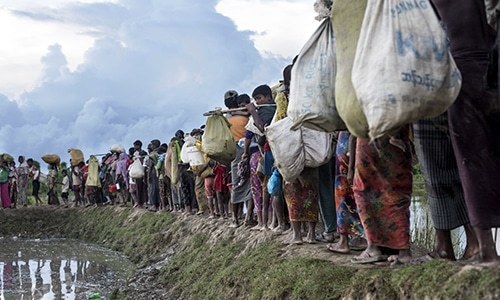
About 700,000 Rohingya Muslims have fled neighbouring Myanmar since last August after an army crackdown which the UN says amounted to “ethnic cleansing”.
They join around 300,000 refugees from earlier violence in mainly Buddhist Myanmar, where the Rohingya are a persecuted and stateless minority.