King Abdullah appoints new Jordan prime minister as protests resume


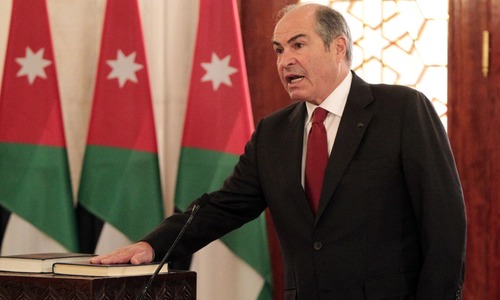
Jordan’s King Abdullah II on Tuesday appointed a new prime minister, the royal palace said, naming a leading reformer as head of government in hopes of quelling the largest anti-government protests in recent years.
Cabinet member Omar Razzaz, a Harvard-educated former senior World Bank official, replaced Hani Mulki, who quit on Monday amid widening protests against his government’s austerity program, including a planned tax increase. Razzaz served as education minister in the outgoing Mulki government.

He taught at the Massachusetts Institute of Technology from 2002 to 2006. From 2006-2010, he served as the World Bank’s country manager in Lebanon, with emphasis on private sector development and infrastructure finance.
Razzaz then returned to Jordan to head the Social Security Corporation, and from 2011-12, let the national team responsible for preparing a national employment strategy.
It’s not clear how much of a reform mandate Razzaz will receive, since the king retains final say on all policy issues.
In the appointment letter addressed to Razzaz, the monarch called on the new government to conduct a comprehensive review of the tax system and produce a new tax bill, in cooperation with parliament, unions and other groups.
He also expressed empathy for ordinary Jordanians who have long complained that they are being asked to pay taxes for poor services. Critics say the current tax proposal unfairly targets the poor and the middle class.
It’s not clear if the appointment of Razzaz will defuse the growing public anger over a long-standing political and economic system widely perceived as corrupt and exclusionary, with benefits reserved for a small elite.
The king blamed the country's economic woes on regional instability, the burden of hosting hundreds of thousands of Syrian refugees and a lack of international support.
"Jordan today stands at a crossroads: either it can come out of the crisis and provide a dignified life to our citizens, or, God forbid, it can go into the unknown — but we have to know where we are going," he told a group of journalists late Monday, according to the official Petra agency.
Protests continue
Protest organisers said they would keep up the pressure, including a one-day strike set for Wednesday, until the proposal has been shelved. Critics say the tax increase unfairly targets the poor and the middle class.

The embattled Mulki, who had led the push for unpopular austerity measures, resigned following several days of mass protests across Jordan against the tax plan, the latest in a series of economic reforms sought by the International Monetary Fund to get the rising public debt under control.
The kingdom has experienced an economic downturn in part because of prolonged conflict in neighboring Syria and Iraq, and a large influx of refugees several years ago. The official unemployment rate has risen above 18 percent, and it’s believed to be double that among young Jordanians.
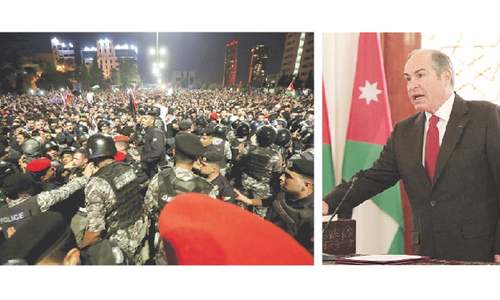
In a sign of continued unrest, protests continued even after Mulki’s resignation. Several thousand Jordanians marched toward the prime minister’s office in the night from Monday to Tuesday.
Riot police scuffled with some of the marchers, trying to keep them away from the building, but the fifth street protest in as many days was largely peaceful.
Protesters said personnel changes at the top are irrelevant without fundamental reforms.