3
3

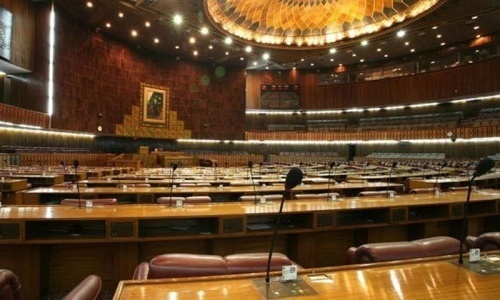
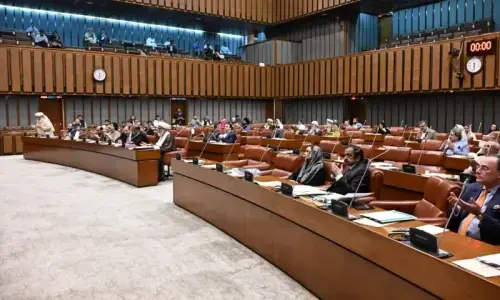
ISLAMABAD: For the first time in the country’s chequered parliamentary history, the third National Assembly in a row managed to complete its five-year constitutional term on Thursday midnight — though it was not a smooth sailing.
However, it is only the second National Assembly under the civilian rule which is completing its tenure as the assembly which came into existence in 2002 continued to function under the military dictator Gen Pervez Musharraf.
The three National Assemblies, however, elected seven prime ministers over the last 16 years, clearly underlying the weakness of democratic institutions and political parties in the country.
Caretaker PM to take oath today
The Ministry of Parliamentary Affairs issued a notification on Thursday afternoon “in pursuance of Article 52” of the Constitution announcing the dissolution of the 14th National Assembly at midnight on May 31, 2018, on completion of its five-year term.
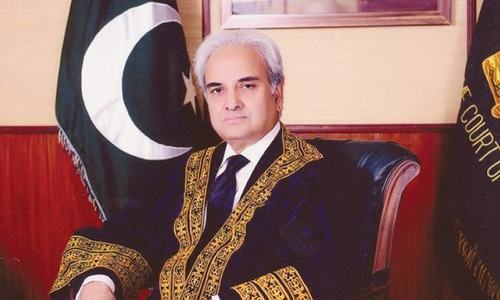
The Presidency has already issued invitations for the oath-taking ceremony of caretaker prime minister retired Justice Nasirul Mulk to be held on Friday morning.
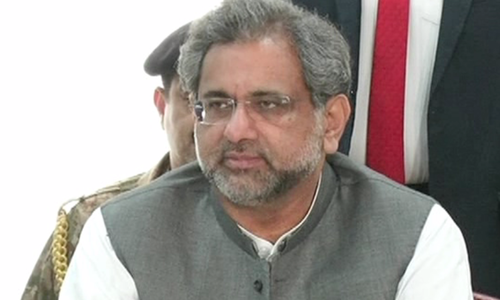
Prime Minister Shahid Khaqan Abbasi spent a busy last day in the office attending the National Assembly’s farewell session, addressing a news conference highlighting his government’s achievements at his office and presiding over separate meetings of the Economic Coordination Committee and the Federal Cabinet.
During his National Assembly address, Mr Abbasi categorically stated that the PML-N would not tolerate delay of even one day in the general elections. He also reiterated his party’s demand of formation of a Truth and Reconciliation Commission to investigate all major political incidents which took place in the country since 1947 to identify those responsible for them.
His demand received a positive response immediately from Opposition Leader Syed Khursheed Shah, who expressed the hope that whoever formed the next government, must do it on priority basis.
Accompanied by Army Chief Gen Qamar Javed Bajwa, the prime minister during his visit to the provincial capital of Balochistan addressed student officers and faculty of Command and Staff College, Quetta.
Mr Abbasi appreciated sacrifices rendered and contributions made by the Pakistan Army in restoring peace to the country.
Since the famous 126-day protest sit-in of the Pakistan Tehreek-i-Insaf (PTI) in 2014 against the alleged rigging in the 2013 general elections, it had never been a smooth sailing for the Pakistan Muslim League-Nawaz (PML-N) government which faced crisis after crisis amid its tense relationship with the two powerful state institutions — military and the judiciary.
Published in Dawn, June 1st, 2018