57
57

WASHINGTON: The US Commission on International Religious Freedom (USCIRF) has again recommended that Pakistan should be declared a ‘‘country of particular concern’’ but the Trump administration, like its predecessors, has refrained.
The USCIRF has been making this recommendation since 2002 but successive US administrations have continued to ignore their advice on the grounds that the proposed designation will fail to promote religious freedom in the country.
On Dec 22, 2017, the US Secretary of State placed Pakistan on a Special Watch List for “having engaged in or tolerated severe violations of religious freedom”. The move caused speculations in the media that this year the administration may declare Pakistan a country of particular interest, triggering a set of new sanctions. But Pakistan escaped the designation this year as well.
The report, however, notes that last year at least 50 individuals were imprisoned on blasphemy charges in Pakistan, with 17 of them receiving death sentences. The annual US report on religious freedom also notes that authorities in Pakistan continue to enforce blasphemy laws, “whose punishment ranges from life in prison to the death sentence for a range of charges”.
The report warns that religious persecution remains a global issue, and in countries like Pakistan, Afghanistan, India, Iran and Russia minorities still face widespread violations of religious freedom.
The report singles out an incident in April 2017, when a mob shot and beat to death student Mashal Khan at Abdul Wali Khan University in Mardan, “following an accusation of blasphemy later deemed by investigators to be false”.
It notes that throughout 2017, unidentified attackers in Pakistan targeted and killed Shias, Hazaras and Ahmadis in attacks believed to be religiously motivated.
Attacks against the Hazara ethnic group increased during the year and in five separate incidents, unidentified assailants shot and killed 15 members of the Hazara Shia community.
Assailants also killed at least seven members of the Ahmadi community in multiple incidents that appeared to be targeted attacks.
The report notes that the Urdu-language media in Pakistan, continued to show bias in reporting on minority religious groups, including multiple instances in which media used inflammatory language or made inappropriate references to minorities.
Afghanistan, India
In Afghanistan, “conversion from Islam to another religion is considered apostasy and is punishable by death, imprisonment, or confiscation of property”, the report adds.
The document notes that the Afghan Supreme Court has declared the Baha’i faith “a form of blasphemy” and conversion to this faith “is punishable by death”.
The Afghan branch of the so-called Islamic State group and the Taliban “continued to target and kill members of minority religious communities”, the report adds.
In India, eight of the 29 states have legislation restricting religious conversion, with laws in force in five of those states.
“Authorities often did not prosecute violence by vigilantes against persons, mostly Muslims, suspected of slaughtering or illegally transporting cows or trading in or consuming beef,” the report notes.
Although, in several cases, it was later proved that the accused persons or their families had never slaughtered a cow.
Under the current Indian government, “religious minority communities felt more vulnerable to Hindu nationalist groups engaging in violence against non-Hindu individuals and places of worship”.
Iran, Russia
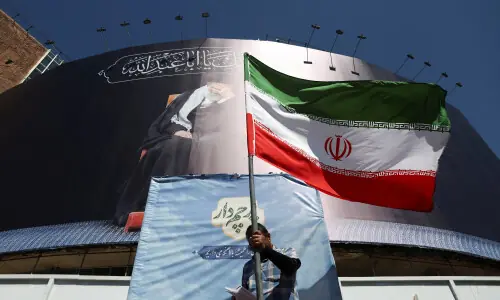
In Iran, the penal code provides for the death sentence for “proselytizing and attempts by non-Muslims to convert Muslims, as well as for insulting figures”.
The report notes that in Russia, the constitution provides for religious freedom but “the government prosecuted individuals of many denominations for unauthorized missionary activity under the amendments to anti-terrorism laws passed in 2016, known as the Yarovaya Package”.
Published in Dawn, May 31st, 2018