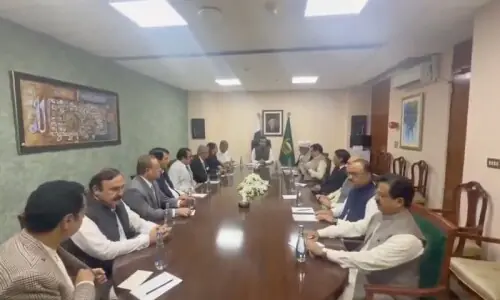
THE air in the Benazir Income Support Programme (BISP) auditorium on May 11 was suffused with celebration. Women from some of the poorest rural areas of Punjab — Okara and Pindi Bhattian — had come to receive awards acknowledging their efforts in enhancing their livelihoods.
These women were part of the 250 beneficiaries graduating out of poverty under the Rural Livelihood Programme launched by BISP in partnership with Nestlé Pakistan. Initially reliant on a monthly stipend of Rs4,848, their income has now reached somewhere between Rs7,000-11,000. A small start, but a start nevertheless.
In line with its Creating Shared Value (CSV) initiative, Nestlé — utilising BISP’s National Socio-economic Registry — had enabled certified beneficiaries to be trained as Nestlé rural sales agents. Involved in door-to-door selling of Nestlé products, the women were eventually encouraged to pursue entrepreneurship by purchasing their own stock, which began from Rs1,000.
In a conservative rural set-up, one expects women to face restrictions by the patriarchal hierarchy; however, on further enquiry, Dawn learned that this did not prove to be an obstacle.
“Surprisingly, no. In fact, we’ve seen a lot of support from their extended families as well,” says Waqar Ahmad, the head of corporate affairs at Nestlé Pakistan. “It’s because their (Nestlé’s sales agents in rural areas) interaction is primarily with people from their own local villages, people they are already familiar with. They feel secure in that knowledge and feel safe in letting the women work.”
Though this serves as an exemplary model for the remaining beneficiaries, it is also a great example of a thriving CSV business concept. For instance, according to reports, the sales generated by BISP beneficiaries crossed Rs4 million in just the first quarter of 2018. Working on the idea of sustainable livelihood, BISP wants to ensure that the graduated beneficiaries are henceforth financially independent.
“We want to steer them towards sustainable livelihood therefore, we are focusing more on BISP gradation programme comprising Business Incubation-Self-Employment (BISE) and direct cash component to pull the beneficiaries out of poverty nexus towards income generating avenues,” says Neelofur Hafeez Director General Complementary Initiatives at BISP. “We have signed MoUs with different organisations like Nestle, Loius Berger, etc.”
Economists now emphasise on graduation programmes to eliminate extreme poverty, as the traditional model of microcredit or cash transfers has been deemed ineffective. In a country such as ours, numerous frauds have been unearthed in cash transfer schemes, depriving the poor of their rights.
The cash transfer model also fails, as beneficiaries, typically women, become increasingly reliant on cash handouts from the government. Women, who form 48.76 per cent of the country’s population, constitute only around 25pc of the workforce.
“Closing the gap between male and female employment can increase production by 30pc,”says Patchamuthu Illangovan, World Bank’s country director Pakistan, adding that such ventures would expedite Pakistan’s journey to becoming a high-income economy in the near future.
A prospering example of a graduation approach to tackling poverty is the one implemented by BRAC — a non-governmental organisation working to alleviate poverty — in Bangladesh in 2002.
Through an ambitious programme titled ‘Challenging the Frontiers of Poverty Reduction: Targeting the Ultra Poor”, BRAC tailored interventions for the targeted population by providing incentives such as productive assets grants (livestock), stipends, healthcare services and skills development training.
By focusing on social development, BRAC ensured 95pc of its beneficiaries graduated, fulfilling the criteria of improving six out of nine indicators: food security, asset ownership, improved housing and school enrolment. Furthermore, 300,000 ultra-poor households had benefitted by 2010.
BISP’s Rural Livelihood Programme also seems to have expanded its scope rather swiftly.
“When we started, we imagined that getting up to 10 beneficiaries in six months will even be a huge success. However, now it’s a completely different story,” says Mr Ahmad of Nestlé. “We are rolling out in Sindh with 10 beneficiaries active in Sukkur and Larkana. We will be rolling out in Khyber Pakhtunkhwa and Gilgit-Baltistan by the end of this year. As we are also building our rural teams, we hope to enrol at least 5,000 beneficiaries by 2021.”
Published in Dawn, The Business and Finance Weekly, May 21st, 2018