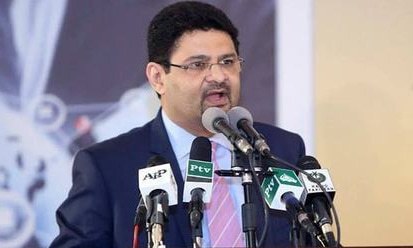
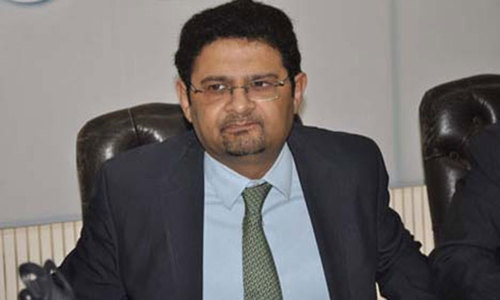
Miftah commits to reimburse Rs100bn tax refund before govt term ends


 3
3


KARACHI: Illegal money exchanges are operating near the Pak-Afghan border, said Federal Minister for Finance, Revenue and Economic Affairs Dr Miftah Ismail on Saturday, adding that the government will restrict illegal movement of foreign currency.
During his day-long engagements with business leaders at FPCCI Brand of the Year Award ceremony and a meeting with Council of All Pakistan Textiles Association (CAPTA), the finance minister informed business leaders that the government is going to present tax amnesty bill before the National Assembly for approval on Monday.
When his attention was drawn towards Chief Justice Mian Saqib Nisar’s observation on the tax amnesty scheme, Mr Ismail said the Supreme Court on its right have the powers to take up the matter. However, he was quick to add that a committee set-up by the CJP had already given its observation which upheld government’s view point on the tax amnesty scheme.
He assured business leaders that before the government’s tenure ends, it will disburse up to Rs100 billion towards outstanding refunds belonging to export trade. The government is also going to announce an export package within the next four to five days, he added.
Giving more details about the illegal mini money exchanges near Pak-Afghan border, the minister said that most of these exchanges are operating near Parachinar and US dollars are being smuggled.
He further said the government is working on plans to put restriction on free movement of foreign currency. The world has changed and free movement of funds and currency are being monitored, he said.
The world over, Pakistani banks are facing lot of hardship and disclosed that recently a penalty of $0.7 million was imposed on National Bank of Pakistan (NBP) in France and Habib Bank Ltd had to pay a penalty of $2.5m in United States, he added.
Points to illegal money exchanges, misdeclaration of trade
The finance minister regretted that heavy revenue losses are being suffered by the national exchange due to unbridled under-invoicing of up to $4bn on imports from China and up to $2.5bn on imports from United Arab Emirates (UAE).
He further said that most of the under-invoicing is being done by commercial importers and that the government is determined to bring this menace to an end because this was having double impact on the economy which includes revenue loss and injury to domestic industry.
During his meeting with the leaders of CAPTA two major issues has to be confronted by the finance minister relating to huge outstanding amount of up to Rs300bn towards refunds on account of sales tax, income tax and Duty on Local Taxes and Levies (DLTL).
The business leaders insisted that if the government fails to payback their funds the exporters who are facing liquidity crunch will collapse because already small and medium sized set-up are closing down.
The other irritant vigorously taken up with the finance minister by these leaders was related to payment against Gas Infrastructure Development Cess (GIDC) because it was also causing liquidity crunch for export trade.
Dr Ismail said the government has its own challenges related to huge trade deficit and current account deficit upon this business leaders said that since the amount of refunds belongs to export trade it should be park somewhere in government accounts.
The business leaders insisted that a mechanism be evolved wherein refunds against which Release Pay Orders (RPOs) have been issued be allowed to get payments from commercial banks because the government was already getting loans for different purposes.
The finance minister assured business leaders to look into the issue of 6 per cent minimum tax imposed in the budget 2018-19 after withdrawing the same as full and final tax. Under new arrangement 6pc would be minimum tax which would mean that tax officials could impose more tax.
The FPCCI leaders were of the view that this will open up flood gate of corruption because tax officials even in the past had been twisting the arms of commercial importers and this caused corruption.
However, demand for reducing the tax rate to 3pc on sales to unregistered persons from 2pc was rejected by the minister.
Similarly, the minister rejected FPCCI’s demand for removal of the NTN (national tax number) condition on purchase of property. However, he assured to look into a way out for overseas Pakistani who would like to purchase property in Pakistan by either using their passport or NICOP.
Published in Dawn, May 13th, 2018