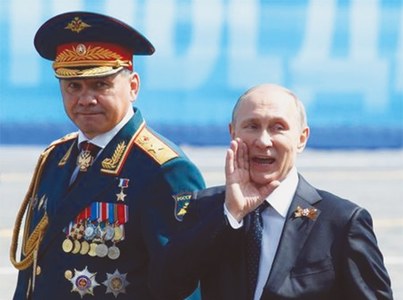
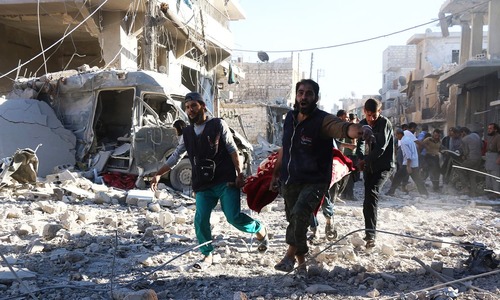
Even as fear of Russia is rising, its military spending is actually decreasing


IN terms of its military presence, Russia has rivalled the United States in recent years, launching major operations in Ukraine and Syria and having rising ambitions in the Arctic.
But its spending power may not match its global ambitions for much longer, numbers by the Stockholm International Peace Research Institute (Sipri) have revealed. While global military spending grew last year, Russia’s fell from $69.2 billion in 2016 to $66.3bn.
It was the first time Russian military expenditure fell since 1998 — the year the country defaulted on its debts.
Throughout the era of President Vladimir Putin, military spending increased continuously, but it could now stay flat or even decrease further over the next few years. The Kremlin’s military spending made up 4.3 per cent of its gross domestic product last year, and there are plans to cut it below 3pc within five years, which could either be achieved through (a rather unlikely) economic growth or radical cuts.
The Kremlin’s plans to cut back on its military comes as military expenditure is on the rise across the world, topping $1.74 trillion in 2017. While US spending still outmatched every other global power, its expenditure remained constant last year. China’s rose once again.
“This should come as a relief for Europe and for Nato,” said Siemon Wezeman, a senior researcher with Sipri. “But of course, budget and intentions are distinct. Russia is still strong enough to make a mess out of things.”
Make no mistake: Russia’s military is still among the world’s most well-funded and its budget ranks fourth worldwide. But military budgets can most easily be slashed by cutting down on foreign operations and procurement, which could result in a declining Russian footprint in places such as Syria. The Kremlin’s willingness to engage in conflicts abroad has been the key reason for Western concerns over its military in recent years.
“At the global level, the weight of military spending is clearly shifting away from the Euro-Atlantic region,” said Nan Tian, a researcher with Sipri, referring to major spending increases in Asia.
So, is that good news for a Europe afraid of Russian military incursions? It very well could be.
Putin continues to be hugely popular in Russia — he won the last presidential election in March with 76.7pc of the vote — even though the country’s economy has been stagnating since 2014. But while Putin’s favourability ratings haven’t suffered as a result, trust in the structures that keep him in power have.
At least some of Russia’s economic woes can be blamed on the nation’s isolation following the annexation of Crimea, resulting in sanctions. Falling oil and gas prices added to the bleak economic outlook.
Russia’s GDP per capita has declined in recent years and about 20 million citizens lived in poverty in 2016, according to the government’s own statistics.
“We need to improve our people’s lives,” Putin said in a speech before his re-election in March. Among the promises Putin made in March were an increase in children’s day care and more funding for road infrastructure improvements. With an economy that has been on the edges of recession for years, Putin has been forced to slash the military budget — even as the country continues to be involved in a number of conflicts abroad.
The poisoning of former Soviet Union double agent Sergei Skripal in Britain have triggered new tensions with the West, but there are also signs that the Kremlin may be willing to strike a more conciliatory tone in an attempt to repair relations with the West and confront the sanctions burden.
“The new political cycle will unfold under the pressure of three unfavourable factors: continuing economic stagnation, international isolation of Russia and the need for preservation of the regime after 2024,” said Kirill Rogov, an independent political and economic analyst, who was quoted by Financial Times.
Invading Europe doesn’t sound like a great solution to tackle any of those problems — much to the relief of officials in Berlin, Paris and Warsaw.
By arrangement with The Washington Post
Published in Dawn, May 3rd, 2018