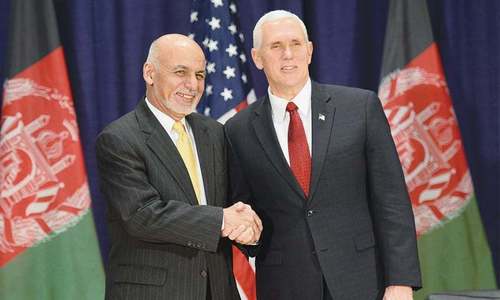
ISLAMABAD: The Foreign Office on Thursday urged all warring factions of Afghanistan to seek a peaceful settlement of the conflict.
“During the past 17 years, the pursuit of a military option has only added to the sufferings and miseries of the Afghan people. We, therefore, urge all sides to focus on resolving the internal Afghan dispute through dialogue,” said FO spokesman Dr Muhammad Faisal at the weekly media briefing.
On Wednesday, the Afghan Taliban announced that they would start their annual spring offensive codenamed Al Khandaq. The announcement poured cold water on the hopes of possible peace talks.
Back in February, Afghanistan’s President Ashraf Ghani had offered unconditional talks to the Taliban. The militant group did not respond to the offer and analysts had speculated that their silence meant that they were thinking about accepting it.
Pakistan had supported President Ghani’s offer for a peace dialogue.
Dr Faisal recalled that Prime Minister Shahid Khaqan Abbasi and President Ghani, during the former’s visit to Kabul earlier this month, had called on the Taliban to respond positively to the peace offer made by the Afghan government and join the peace process without further delay.
Pakistan, the spokesman said, had always maintained that there was no military solution to the conflict in Afghanistan. The only viable way forward, he maintained, was a politically negotiated settlement through an Afghan-led and Afghan-owned peace process.
Afghan ambassador to Pakistan Omar Zakhilwal, Voice of America reported, had acknowledged that the Taliban’s spring offensive was a rejection of the government’s peace overture.
In a major raid after the announcement of the spring offensive, the Taliban in an attack in the northern Kunduz province killed around 14 Afghan soldiers.
Commenting on the acquittal of the accused in the Hyderabad (India) Mecca Masjid blast case by Indian courts, Dr Faisal said the decision made a travesty of the Indian judicial system.
Five accused including Swami Aseemanand, who has been linked to three terrorist attacks, were recently acquitted in the 2007 blast in Hyderabad’s Mecca Masjid.
“India is making a complete mockery of its justice system, especially while dealing with Saffron terrorism and terrorist acts committed under the garb of Hindutva and Hindu fundamentalism,” Dr Faisal said.
“India is quick to indulge in pointless blame game, labelling everything as terrorism, for political point-scoring, often without substance or evidence but that quickness does not extend to ensuring justice for the real victims,” he added.
He also regretted the lack of progress in the Samjhauta Express attacks in which a number of Pakistanis travelling back home lost their lives.
“We have regularly lodged our concern with India regarding the lack of progress in the Samjhauta terrorist attacks, in which more than 42 innocent Pakistanis lost their lives, despite a lapse of more than a decade,” he said.
He said Col Purohit and Swami Aseemanand were both masterminds of the deadly attack.
Published in Dawn, April 27th, 2018