40
40

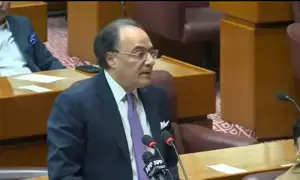
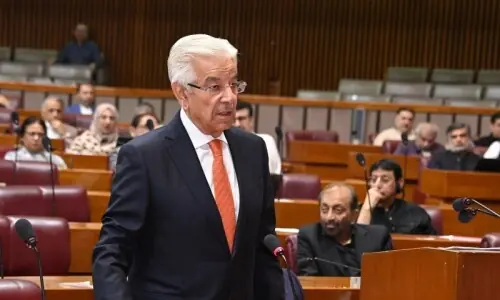
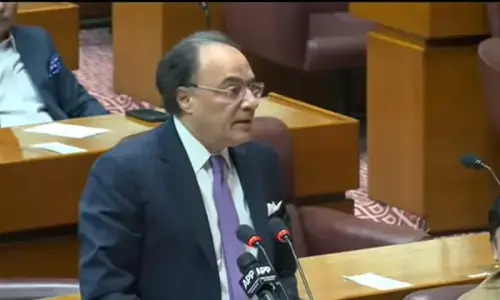
Foreign Minister Khawaja Asif on Friday told lawmakers that Pakistani troops have been stationed in the Kingdom of Saudi Arabia for 'internal security' reasons, not to take part in the Yemen war, as other lawmakers had feared.
The minister made the assurance while delivering a policy statement in the National Assembly in connection with the army's Feb 15 announcement that it was sending troops to Saudi under an existing bilateral security pact.
Lawmakers from both the upper and lower houses had expressed reservations regarding the implications of the move, and NA Speaker Ayaz Sadiq had directed the Foreign Ministry to explain its decision.
Asif today told MNAs that though soldiers had been stationed in KSA, "We have not taken part in any across-the-border action by Saudi Arabia".
He assured lawmakers that Islamabad had not become a party to the Yemen war, adding: "We want Saudi Arabia and Iran to bridge their differences."
The minister also discussed various crises in the Middle East and, without naming the United States (US), appeared to hold the superpower responsible for unrest in the region.
Terming the Syrian conflict a "fight for power", Asif said that although he did not support dictatorship, "at least human lives were safe" under dictators in Syria. He also claimed that Iraq, Libya and other Middle Eastern countries had been destabilised in line with a conspiracy designed to scatter the Muslim ummah.
Asif also said "the powers which destabilised Afghanistan, Iraq, Syria and Libya were not Pakistan's well-wishers".
He then turned to the South Asia region and said that Pakistan had fought a "made-in-America jihad" against Russia in Afghanistan. "We committed the same mistake after 9/11," he said, criticising former rulers and accusing them of selling out for personal gain.
Despite the presence of the US with all its military might in Afghanistan, the production of heroin has increased from 200 tonnes to 9,000 tonnes, he complained.
"The Taliban are operating in 43 per cent of Afghanistan, and yet they blame us for facilitating the Haqqani Network," he said.
"Everyone knows who introduced the militant Islamic State group to Afghanistan," he added.
"The US wants Pakistan to become a proxy and defend its interests in Afghanistan, but we will not defend anyone else's interests," he added.
"Pakistan will only defend its own interests," Asif asserted.
Referring to cross-border skirmishes at the Working Boundary, the foreign minister claimed to know "what is going on" at the border, adding: "We know our enemy very well," and that facilitators had yet to be identified.
"Unfortunately, Muslim countries are not united on even a single issue, nor are they ready to talk to each other," he complained, adding that the Muslim Ummah does not seem to need an external enemy.
"The Ummah seeks our help during their time of hardship, so we [Pakistan] have become a target of anger [of some international powers]," he claimed.