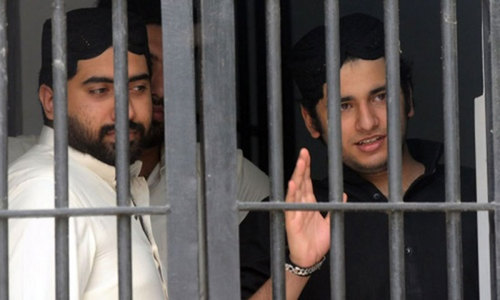
The Supreme Court (SC) on Saturday admitted a civil petition regarding the Shahzeb Khan murder case and ordered the placement of all suspects on the Exit Control List (ECL) while issuing bailable arrest warrants for them, DawnNews reported.
Chief Justice Mian Saqib Nisar, who was hearing a petition filed by civilians regarding the reliefs granted to men believed to have murdered Shahzeb, directed the Federal Investigation Agency and Interior Ministry to notify all airports and ensure that the suspects do not leave the country.
During the hearing, the SC's Karachi registry also admitted a petition challenging the Sindh High Court (SHC) decision to strike out terrorism charges from the case as 'maintainable'.
Lateef Khosa and Babar Awan, who were representing Shahrukh Jatoi and Ghulam Murtaza Lashari respectively, argued that the murder of Shahzeb Khan had been a personal crime and could not be classified as an act of terror.
"The incident took place at 1.30am. There was no one else at the crime scene who might have been terrorised by [the murder]", Khosa argued.
He said the fight between Shahrukh and Shahzeb had started with a slap and ended with a gunshot, adding that since the victim was the brother of the girl being harassed by Shahrukh's accomplices, he managed to gather the public's sympathy.
Khosa further said that none of the witnesses of the case believed it to have been an act of terrorism.
The prosecution lawyer Faisal Siddiqui, however, insisted that if Shahzeb's murder would not have been an act of terrorism, the civil society would not have filed a petition to challenge the SHC's decision.
Siddiqui went on to argue that the SHC had overlooked important legal aspects of the case. He also reminded the court that the SC had not objected when the case's challan was first submitted in the SC — after then chief justice Iftikhar Mohammad Chaudhry had taken suo motu notice of the case in 2012 — even though it had included terrorism clauses.
Siddiqui argued that Shahzeb's murder had a wide impact and had sparked nationwide protests, and should, therefore, qualify as an act of terrorism. The CJP, however, took this argument with a grain of salt, saying that the court will make a decision in accordance with the law instead of relying on public opinion and protests.
In November, 2017, the SHC had set aside the death penalty awarded to the convicts in the Shahzeb murder case and ordered a retrial after Shahrukh Jatoi's lawyer, Advocate Farooq H. Naek, successfully argued that terrorism charges should not have been included in the case.
Chief Justice of Pakistan (CJP) Mian Saqib Nisar has ordered that the convicts appear in court for the next hearing of the case, but adjourned the hearing indefinitely.
The murder of Shahzeb Khan
On the night of December 24, 2012, 20-year-old Shahzeb Khan, the son of Deputy Superintendent of Police Aurangzeb Khan, had been gunned down in Karachi's Defence Housing Authority. He was returning home with his sister from a wedding.
Shahzeb was killed for picking a fight with one of the suspects’ servants, who had verbally threatened and harassed his sister.
Then chief justice Iftikhar Chaudhry had taken suo motu notice of the incident, which sparked widespread outrage across the country through newspapers, TV channels and social media.
As the prime accused belonged to powerful feudal families of Sindh, the incident had triggered a nationwide debate over whether the country’s elite could be held accountable for crimes they committed.
Later, after a speedy trial, Judge Ghulam Mustafa Memon of Anti-Terrorism Court-3 sentenced Shahrukh Jatoi and co-accused Nawab Siraj Talpur to death. Sajjad Talpur and Ghulam Murtaza Lashari, the Talpurs’ servant, were handed life imprisonment for their involvement in the murder.
A couple of months after the sentence, however, Shahzeb's parents had issued a formal pardon to the convicts.