Civil-military brass won’t ‘react in haste’ to Trump tweet

ISLAMABAD: Rejecting US President Donald Trump’s anti-Pakistan tweet as “unwarranted”, the country’s top civil and military brass on Tuesday vowed not to act in haste, while agreeing to remain committed to the peace process in Afghanistan.
An official statement issued after a meeting of the National Security Committee (NSC) — the apex civil-military forum in the country chaired by Prime Minister Shahid Khaqan Abbasi — said the decision was being taken not just for the sake of the people of Pakistan, but in the interests of the peace and security of the wider region and the international community.
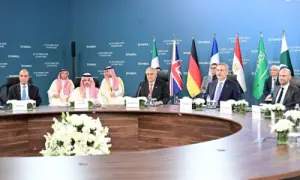
The meeting was attended by Foreign Minister Khawaja Asif, Interior Minister Ahsan Iqbal, Defence Minister Khurram Dastgir, Chairman Joint Chiefs of Staff Committee Gen Zubair Mehmood Hayat, Chief of the Army Staff Gen Qamar Javed Bajwa, Naval Chief Admiral Zafar Mahmood Abbasi, Air Chief Marshal Sohail Aman, PM’s Adviser on Finance Miftah Ismail, National Security Adviser retired Lt Gen Nasser Khan Janjua, Pakistan’s Ambassador in Washington Aizaz Ahmad Chaudhry, and other senior civil and military officials.
The meeting, which was called at short notice to review the emerging strategic situation in the region and beyond, reaffirmed that Pakistanis were capable of defending their country and had demonstrated an exceptional commitment to countering terrorism.
The body expressed deep disappointment with some of the recent statements from the US leadership, and observed that close interaction with the Trump administration following the initial pronouncement of his policy on South Asia had been useful for creating a better understanding of each other’s perspectives on the best way to achieve durable peace and stability in Afghanistan.
National Security Committee, Corps Commanders meetings discuss regional, global strategy
The recent visits by Secretary of State Rex Tillerson and Defence Secretary James Mattis were also seen as “robust and forward-looking”.
Given this positive progression, the recent statements from the US leadership were completely incomprehensible, as they contradicted the facts and insensitively struck at the trust built between the two nations over generations, negating the decades of sacrifices rendered by the Pakistani nation.
According to the official communiqué, participants of the meeting noted that over the past several years, Pakistan’s counterterrorism campaign had served as a bulwark against the possible expansion of scores of terrorist organisations currently present in Afghanistan — a fact acknowledged by US authorities at the highest levels.
Most of these terrorists have repeatedly launched cross-border attacks against innocent Pakistanis with impunity, exploiting the presence of millions of Afghan refugees in Pakistan, the porous Pak-Afghan border and large tracts of ungoverned spaces inside Afghanistan.
The NSC observed that Pakistan had fought the war on terrorism primarily out of its own resources and at great cost to its economy. It noted that the sacrifices, such as the tens of thousands of Pakistani civilians and security personnel who had laid down their lives — and the pain of their families — could not be trivialised so heartlessly by assigning it an “imagined” monetary value.
“Even today, Pakistan [is] firmly supporting the US-led international effort in Afghanistan… continuously facilitating this through vital lines of communications for smooth counterterrorism operations in Afghanistan,” the meeting noted, adding that as a result of Pakistan’s counterterrorism operations, Al Qaeda had been decimated from the region.
It was mostly because of this support that Pakistan was suffering a brutal backlash, which included the killing of over a hundred schoolchildren by terrorists based in Afghanistan.
The real challenges in Afghanistan, the committee observed, are “political infighting, massive corruption, phenomenal growth of drug production and expansion of ungoverned spaces inside Afghanistan full of sanctuaries for multiple international terrorist organizations”, which posed a serious and direct threat to Afghanistan, its neighbours and the entire region.
“Pakistan cannot be held responsible for the collective failure in Afghanistan and blaming allies certainly does not serve the shared objective of achieving lasting peace in Afghanistan and the region.”
Earlier in the day, a Corps Commanders’ Conference was held at the military’s General Headquarters in Rawalpindi to review “the evolving geo-strategic environment”. Chaired by Gen Bajwa, an Inter-Services Public Relations statement said that the huddle also discussed input for the NSC meeting.
Also on Tuesday, a member of the federal cabinet described Donald Trump’s Twitter tirade as ‘condemnable’, and accused him of “speaking the language of India”.
In a statement, Minister for Kashmir Affairs Birjees Tahir lamented that since assuming office, President Trump had continued his diatribe against Pakistan
He said Trump continued to issue irresponsible statements against different countries, and did not even spare friendly countries, adding that saner elements within the US were sick of his irresponsible behaviour and follies.
Published in Dawn, January 3rd, 2018