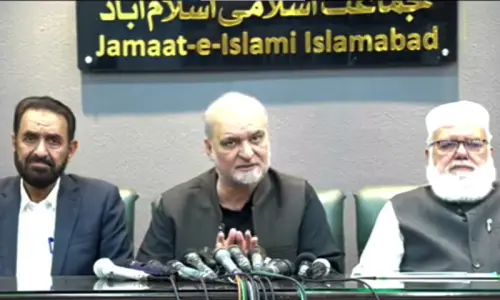
ISLAMABAD: National Command Authority’s adviser retired Lt Gen Khalid Kidwai on Wednesday shed rare light on the ‘Full Spectrum Deterrence’ policy that guides the development of nuclear capability, saying it aimed at bringing every Indian target into Pakistan’s striking range.
Gen Kidwai, who founded the Strategic Plans Division and headed it for nearly 14 years, was speaking at a seminar on “Defence, Deterrence and Stability in South Asia” co-hosted by local think tank Center for International Strategic Studies (CISS) and London’s International Institute for Strategic Studies (IISS).
The three elements of Full Spectrum Deterrence (FSD) shared by Gen Kidwai envisaged possession of “full spectrum of nuclear weapons in all three categories — strategic, operational and tactical, with full range coverage of the large Indian land mass and its outlying territories”.
Gen Kidwai said it meant India would have “no place to hide”.
The second element says that Pakistan should have “appropriate weapons yield coverage and the numbers to deter the adversary’s pronounced policy of massive retaliation”. He explained that this implies that “counter-massive retaliation punishment will be as severe if not more”.
The third aspect is about the “liberty of choosing from a full spectrum of targets, notwithstanding the Ballistic Missile Defence, to include counter-value, counter-force, and battlefield” targets.
FSD was approved by the National Command Authority — the principal policy making body on research, development, production, use and security of the country’s nuclear programme — at its meeting on Sept 5, 2013. The policy was developed in response to India’s war fighting concepts of ‘Cold Start’ and Pro Active Operations (PAO) to provide a range of options to the decision-makers.
Pakistan calls its nukes the weapons of peace. Gen Kidwai reiterated that by saying that Pakistan’s “robust nuclear capability” and the policy of ‘Full Spectrum Deterrence’ reduced the chances of war.
“Because of mutually assured destruction there is unlikelihood of a hot war or a conventional war and, therefore, the conflict has shifted towards sub-conventional level. As of now, that could be seen in full play at our Western borders,” Gen Kidwai said, recalling the public pronouncements by Indian leadership of using terrorism to destabilise Pakistan.
IISS Team Leader Desmond Bowen spoke about the difference in understanding of deterrence in the West and South Asia. He also underlined the risks associated with the nuclear capability.
“Security of Pakistan is a sovereign responsibility and so is the calculation of risk in these matters. How manageable are those risks now, but above all in times of crises,” he said.
CISS Executive Director Sarwar Naqvi gave an overview of the regional trends. He observed that Pakistan was deeply sceptical of President Trump’s South Asia policy. Meanwhile, in relations with India, he noted, the stalemate was persisting.
Mr Naqvi expressed concern over nuclear politics rhetoric and the introduction of technologically advanced and sophisticated nuclear weapons.
Published in Dawn, December 7th, 2017