5 things you should know about Jerusalem


Jerusalem is once again stirring powerful emotions around the world after US President Donald Trump recognised the city as Israel's capital on Wednesday.
Here are five things to know about the divided city:
Current status
Israel seized control of Palestinian's east Jerusalem from Jordan during a 1967 war and later annexed it. The move was never recognised by the international community but Israel declared the city its undivided capital. The Palestinians see east Jerusalem as the capital of their future state.
No countries [now except the US] have accepted Israeli sovereignty and have their embassies in the commercial capital Tel Aviv instead. The city's eastern sector contains some of the sites holiest to Judaism, Islam, and Christianity.
Divided population in the holy city
Jerusalem's population is divided not only between Israeli Jews and Palestinians but also within the Jewish population, with over a third of the city's 542,000 adult Jewish residents defining themselves as ultra-Orthodox, according to the Central Bureau of Statistics.
The ultra-Orthodox are the fastest growing segment in the city, with over two-thirds of elementary school children enrolled in their schools in Jerusalem.
Palestinians in Jerusalem have Israeli residency and access to services.
Most Palestinians do not partake in municipal elections and cannot vote in parliamentary elections. NGOs in support of them denounce what they describe as the unequal distribution of resources and services in east and west Jerusalem.
Life in Jerusalem
Alongside the religious sites, institutions, and people, Jerusalem is host to Israel's top higher education facility, the Hebrew University, whose founding fathers include Albert Einstein and Sigmund Freud.
The Bezalel Academy of Arts and Design, Sam Spiegel Film and Television School and Nissan Nativ acting studio are some of the institutions that draw Israel's most talented artists.
The Palestinian National Theatre is among the rare Palestinian institutions located in Jerusalem. Israeli authorities do not allow the Palestinian Authority to operate in the city.
Tourism capital
According to the Central Bureau of Statistics, 78 per cent of the three million tourists who entered Israel in 2016 visited Jerusalem.
The most popular destinations were the Western Wall along with the Christian holy sites at the Church of the Holy Sepulchre and Via Dolorosa, all in the walled Old City.
Other popular tourist sites are Holocaust memorial Yad Vashem and the Israel Museum, home to a collection of nearly 500,000 objects of art and archaeology, ancient and modern, including the Dead Sea Scrolls which date back more than two millennia and include some of the earliest texts from the Bible.
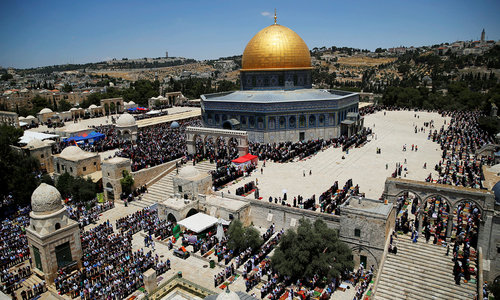
Muslim pilgrims visit the Al-Aqsa mosque compound, the third-holiest site in Islam. The compound is known to Jews as the Temple Mount, their holiest site.
Jerusalem Syndrome
Jerusalem is one of the few cities worldwide to have a psychiatric condition named after it. The rare condition affects tourists who come to visit holy sites of Christianity, Judaism and Islam and suddenly find themselves overwhelmed by it all, believing themselves to be characters from the Bible, Dr Grigory Katz, a psychiatrist at Jerusalem's Kfar Shaul Mental Health Center and an expert on the syndrome, said.
The syndrome is rare, but when it strikes, it usually affects Protestant pilgrims from small-town America or Scandinavia raised in pious families whose trip to the Holy Land may be their first ever abroad.
Many of those afflicted by the condition become convinced they are Jesus Christ, the Virgin Mary or some other character from the Bible, but symptoms don't tend to last long, and medication can help bring patients back to “normalcy” within days.