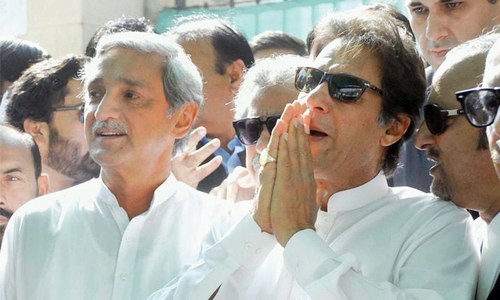
An Anti-Terrorism court (ATC) in Islamabad on Friday ordered Pakistan Tehreek-i-Insaf (PTI) Chairman Imran Khan to record his statement in four cases — including the Asmatullah Junejo assault case — registered after the PTI's months-long 2014 dharna which left the capital city paralysed.
The court had earlier dismissed Khan's written statement in the case as inadmissible, but had granted him pre-arrest bail in all four cases on Nov 14.
As the hearing began, Khan's lawyer Advocate Babar Awan tried to push for Khan to be exempted from appearing in court, upon which the judge asked if a defendant on pre-arrest bail could be granted an exemption from court appearances.
Awan responded that an exemption could be granted, but the government's lawyer argued against an exemption being granted to Khan.
Soon after the exchange, Awan announced that Khan would be making an appearance in court soon.
ATC Judge Shahrukh Arjumand instructed Awan to coordinate with the Investigation Officer (IO) to decide upon a date and time for the PTI chief to record his statement before the IO.
The case was adjourned until December 7.
'No comparison between me and Nawaz'
The PTI chairman, speaking to journalists outside court, said that there is no comparison between him and Nawaz Sharif, since he was willing to go to the police station to aid the investigation and strengthen the judicial system, whereas "Nawaz Sharif is maligning the judiciary, the army and all other institutions for his own gain."
Khan added: "Comparing me to Nawaz is like comparing me to Sultana daku."
Referring to this 2014 dharna, Khan claimed the sit-in was "politically driven".
"We came out on the streets to protest rigging that took place in the 2013 election. Such protests happen all over the world," he added.
"These cases have been slapped onto us to silence us, but that will never work."
Pending cases against Khan
In 2014, Khan and Pakistan Awami Tehreek Chairman Tahirul Qadri had staged a major rally in Islamabad against alleged rigging in the 2013 election and the Model Town tragedy, which had seen as many as 14 people killed and 100 others injured when police attacked Qadri's residence during an 'anti-encroachment' operation.
Khan had threatened to shut down the entire country in what was perceived as a bid to topple the government. The protest had continued for a record 104 days.
On Sept 1, 2014, while the sit-in was still ongoing, Senior Superintendent of Police (SSP) Asmatullah Junejo had been beaten up by protesters on Constitution Avenue as they stormed the Pakistan Television (PTV) headquarters and the precincts of the Parliament.
A case had been registered against Khan, Qadri and others for torturing SSP Junejo and five other police officers. Arrest warrants had also been issued against the two leaders.
Earlier this month, ATC Judge Shahrukh Arjuman granted bail to the PTI chief against surety bonds of Rs200,000 per case after he unexpectedly appeared before the court.