14
14

PML-N leader Hanif Abbasi on Tuesday filed before the Supreme Court a written response pertaining to the "nature of a beneficial interest in trust relationships."
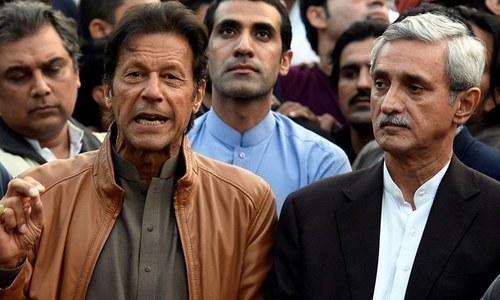
On Nov 15, a three-member bench of the apex court — headed by Chief Justice Saqib Nisar and comprising Justice Faisal Arab and Justice Umar Ata Bandial — had concluded hearing a petition filed by Abbasi against Pakistan Tehreek-i-Insaf (PTI) Chairman Imran Khan and party's secretary-general Jahangir Tareen.
The petition seeks the disqualification of the two PTI leaders.
As the apex court had reserved its verdict in the case, the chief justice had asked the petitioner as well as the respondents to submit additional written material if they wanted to.
The response submitted by Abbasi on Tuesday stated that, according to Black's Law Dictionary, a trust should be considered to be an asset.
It further identifies a bare trust ─ "which has a single beneficiary" ─ as one in which "the beneficiary has an identifiable, equitable interest in some property." The response states that the case against Imran "involves a bare trust."
It argues that Imran's offshore company, Niazi Services Limited, operated on his instructions and it therefore cannot be said that the PTI chief is not the owner of the company.
The response also states that the case concerning Tareen involves a discretionary trust where "although the beneficiary has an interest in the trust [sic] there is no commitment on the part of the trustee to confer on him the benefit of any defined property."
"It is within the discretion of the trustee as to who, one or more, of the beneficiaries shall have the benefit of the trust property."
"Nevertheless, a beneficiary under a discretionary trust has an 'interest' to be considered as a potential recipient of benefit under the trust and a right to have his interest protected by the court of equity," the response states.
"The whole class of beneficial beneficiaries, under a discretionary trust, can call upon the trustee to surrender the property according to the instructions of the beneficiaries."
The response states that Tareen therefore cannot refuse ownership of a trust through which he had bought property in Britain. In a previous hearing of the case, Tareen's lawyer had told the court that the trust was established on May 5, 2011.
The response concludes that "anything that can be disposed of for value is, by definition, an asset."
"Therefore, in the cases of Imran Khan Niazi and Jahangir Tareen, their interest in the trust property was in the nature of a proprietary interest that could be disposed of, and constituted as an asset."
Abbasi's response maintains that Tareen and Imran did not disclose the trust and the offshore company, respectively, in their nomination papers.
When the court reserved its verdict in the case, the chief justice had told all parties not to expect an early decision. A week later, it has still not been announced when the verdict will be issued.