South Korea, China seek to thaw frozen ties


South Korea and China will push to normalise ties that were badly strained over the deployment of a contentious United States (US) missile defence system in the South, both countries announced Tuesday, with Seoul saying their leaders are set to hold summit talks next week.
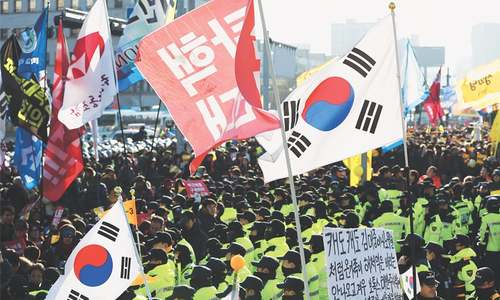
South Korea allowed the US to install the Terminal High-Altitude Area Defence (THAAD) system on its soil this year, triggering angry rhetoric and economic retaliation from China which views THAAD's powerful radar as a threat to its own security.
South Korea and the US have repeatedly said the system is only aimed at defending against North Korea's advancing nuclear threats, rather than peering into Chinese territory.
On Tuesday, Seoul's Foreign Ministry said there was recently diplomatic communication between the two countries, during which they agreed to put bilateral exchange and cooperation back on a normal track soon and boost cooperation for a peaceful, diplomatic resolution of the North Korean nuclear issue.
The ministry statement said Beijing reaffirmed its opposition to THAAD and asked South Korea to handle "relevant issues appropriately", while South Korea reiterated the system doesn't target China.
It said military officials of the two countries will discuss Chinese worries about the THAAD system.
Seoul's presidential office announced separately that S. Korean President Moon Jae-in and Chinese President Xi Jinping will hold summit talks next week on the sidelines of an annual regional forum in Vietnam.
It would be their second one-on-one meeting since Moon's inauguration in May.
China's Foreign Ministry in its own statement did not mention a summit.
In that statement, Beijing repeated its objection to the anti-missile system but it indicated an interest in improving ties.
It said both sides attached great importance to their relationship and were willing to push forward on developing a cooperative partnership.
Lu Chao, a Korea expert at Liaoning Social Sciences Academy, said the Xi-Moon summit could set the stage for more hi-level talks, including by military officials.
Tuesday's announcements by the two countries came after Xi consolidated his already considerable power at a twice-a-decade Communist Party congress that concluded last week.
Efforts have been recently made to improve ties, with neither country expected to gain much from a protracted standoff over the THAAD issue.
Many analysts say China appeared to use its THAAD opposition to bolster its regional clout but that such a stance could push South Korea closer to the US and Japan for a potential anti-Beijing trilateral alliance.
In South Korea, there have been growing worries about frosty ties with China, which is its largest trading partner and some South Koreans say might one day replace the US as the world's sole superpower.
In retaliation for the THAAD deployment, Beijing suspended visits to South Korea by Chinese tour groups and trips to China by South Korean entertainers. South Korean retail and auto businesses in China suffered anti-South Korea sentiments.
The countries' top envoys to stalled regional talks on North Korea's nuclear programme were to meet in Beijing on Tuesday.
Earlier this month, South Korean and Chinese officials agreed to extend their currency swap deal.
In August, Xi said he was willing to work with Moon on addressing differences between the two countries.
China is North Korea's main trading partner and last major diplomatic ally, making its cooperation crucial to the success of international sanctions on the North's weapons programs.
The North was slapped with new, tough UN sanctions after it conducted its sixth and most powerful nuclear test in September.