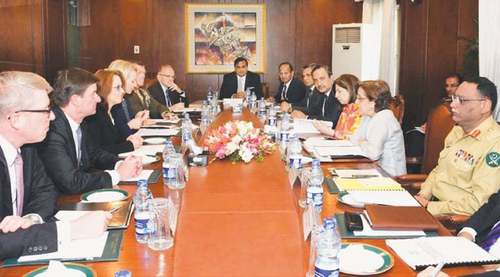
THE last couple of weeks have seen much diplomatic activity between Pakistan and the US.
I am struck by the overly positive read-out of the engagement in Pakistan’s media. True, these efforts signify that the threat of an imminent breakdown of ties in the wake of US President Trump’s unveiling of his administration’s Afghanistan strategy has been averted. Still, we need to temper expectations. Ties remain in trouble. This won’t change unless common ground is found on issues that really matter. One-off successes like the freeing of the kidnapped American-Canadian couple will offer breathing space — no more.
For some years, Pakistan-US ties have been marked by persistent demands on both sides for the other to do more. However, there was also a recognition that they won’t get nearly as much as they were asking for, and, more importantly, that there weren’t any extreme measures worth the cost to force the other side to concede.
The US has continued to press the issue of the Haqqani network and Afghan Taliban sanctuaries. Yet, previous administrations shied away from coercive measures against Pakistan, seeing these options as cost-prohibitive. Pakistani officials remained paranoid about America’s long-term regional intentions. Still, there was no serious effort to pursue a regional policy without some sort of partnership with the US.
The desire to continue engaging remains intact on both sides. But the US ask that Pakistan eliminate Afghan insurgent sanctuaries has not changed. This is now a one-point agenda. Every conversation about Pakistan’s long-term importance is in cold storage; the talk in Washington of employing coercive measures is louder than ever. Further, the current US foreign policy orientation holds a strong preference for quick, tangible results.
There’s no room for complacency in Pak-US ties.
The dynamic on Pakistan’s side doesn’t instil much confidence in the future of ties either. Pakistani officials sense the delicacy of the moment and thus will want to work out feasible concessions to the US that signal positive intent and avoid harsh action. Beyond this though, acquiescing fully to the US ask regarding the Haqqanis and Taliban has never been seen favourably. If anything, the current environment will likely reinforce the reluctance to bite the bullet.
I sense consensus within Pakistani officialdom on two points: the new US strategy is seen as one aimed at defeating the Taliban on the battlefield rather than politically accommodating them; and that this approach is certain to work to Pakistan’s disadvantage (and to India’s advantage). Corollary: all-out support to the strategy will continue to be seen as self-defeating. Also, while the aura of unpredictability around US foreign policy in general is making decision-makers nervous, it is also forcing some within the system to argue that Pakistan must proactively plan for a minus-US scenario.
If so, Pakistan’s current engagement with the US may signify a buy-time approach. Meanwhile, one could expect Pakistan to proactively try and influence US strategy, most likely by pushing for a politics-first approach that seeks to accommodate the Taliban sooner rather than later.
Here’s the problem. The US is set to remain focused on the sanctuaries and opposes any proposal that may detract from this. Pakistan will be hoping to use its initial flexibility (for example, by actions such as freeing the hostages) to pull Washington away from its maximum ask. Yet, the Washington policy community may interpret Pakistan’s flexibility as evidence that Trump’s tough talk is working. The inclination would be to hunker down further. But desired results on the US’s principal ask will still not be forthcoming.
At the same time, Pakistan’s political appetite to absorb public rebuke would be limited in an election year. Any propensity by the political elite to respond emotively will further empower the Washington voices who want to see Pakistan punished. And as temperatures rise, those within the Pakistani system advocating a minus-US formula will gain traction. This is a recipe for disaster.
For things to work out differently, both sides must acknowledge the elephant in the room: a mutual feeling that each side’s preferred endgame in Afghanistan is unacceptable to the other.
Pakistan believes the US is pursuing a ‘basing’ strategy that will leave its troops and bases in Afghanistan indefinitely. The goal, as internalised by the policy enclave, would be to keep the region (Pakistan, China, Russia, Iran) off-balance; India would gain further ground. The US is convinced that Pakistan continues to provide active support to Afghan insurgents to prevent US gains and keep the Taliban strong to counter India. But the US does not buy Pakistan’s take on India; it sees the military as paranoid in this regard.
These deep divergences are not easily reconciled. Yet, till they are, the ties will remain on the brink.
The writer is a foreign policy expert based in Washington, D.C.
Published in Dawn, October 17th, 2017