Swedish university finds Arabic characters in Viking Age script
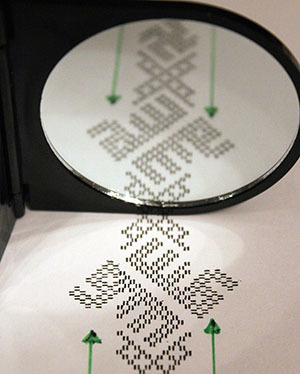


Researchers working to recreate textile patterns for an exhibition in Sweden have discovered that the woven bands of silk in burial costumes found in Viking Age boatgraves contained inscription in Kufic, an ancient Arabic script.
This information was shared by Sweden's Uppsala University in an article on its website after researchers behind the study showed that the words 'Allah' and 'Ali' are invoked in the patterns of the bands.
“One exciting detail is that the word ‘Allah’ is depicted in mirror image,” said Annika Larsson, researcher in textile archaeology at the Department of Archaeology and Ancient History at Uppsala University.
According to the article, it was while working to recreate textile patterns for the Viking Couture exhibit at the Enköping Museum in Sweden's Enköping that the researchers discovered that the woven bands contained the ancient Arabic script. The Kufic characters were found in the Viking Age in mosaics on burial monuments and mausoleums, primarily in Central Asia.
Similar Kufic characters appear in the grave costumes in Viking Age chamber graves in central sites in Sweden, such as Birka in Mälardalen, as well as in boatgraves in the area around Gamla Uppsala.
“It is a staggering thought that the bands, just like the costumes, was made west of the Muslim heartland. Perhaps this was an attempt to write prayers so that they could be read from left to right," the article quotes Larsson as saying.
"Presumably, Viking Age burial customs were influenced by Islam and the idea of an eternal life in Paradise after death."
Viking Couture exhibition
Larsson’s research findings are being presented as part of the Viking Couture exhibition at Enköping Museum, according to the article. The project is funded by the Swedish Foundation for Humanities and Social Sciences, which is conducting a pilot project aimed at presenting new research in the form of exhibitions.
The project uses research methods other than the usual theoretical so that the results reach a wider audience than just academics. Exhibitions are largely based on visual communication, and one method for this is recreation processes, such as that of the textile bands.
Viking Age
The Viking Age is the period from the late 8th century to the mid-11th century in European history. According to History.com, the Vikings — contrary to some popular conceptions — were not a “race” linked by ties of common ancestry or patriotism, and could not be defined by any particular sense of “Viking-ness.”
Most of the Vikings whose activities are best known come from the areas now known as Denmark, Norway and Sweden, though there are mentions in historical records of Finnish, Estonian and Saami Vikings as well. Their common ground, according to History.com, was that they came from a foreign land, they were not “civilized” in the local understanding of the word and they were not Christian.