96
96

Two female college students in Jhelum were found to have been playing the dangerous Blue Whale challenge, a game that encourages self-harm and eventual suicide among its victims, after it emerged that they had inflicted injuries on their arms with a blade.

The two girls, who were students of grade 11 and 12 at Government Girls Degree College Pind Dadan Khan in Jhelum, were expelled from the college after the revelation, officials told DawnNews.
Raheela Chandni, the college principal, called the students' parents to explain the situation after tip-off from a third student who discovered that the girls had been playing the game.
The principal told DawnNews that she decided to expel the two girls after talking to their parents so as to "prevent other students of the college from being influenced" by the phenomenon.
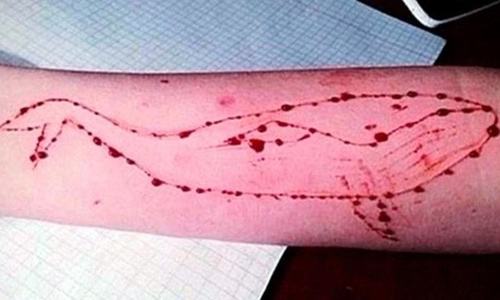
One of the two girls had reached level 18 of the game, while the other was playing level 22. Both had made carvings on their arms using a sharp-edged tool.
What is Blue Whale?
The Blue Whale challenge is an online game in which the administrator (also known as the curator) sets challenges and tasks for the player over a 50-day period. Players are encouraged to perform acts of self-harm, such as carving the outline of a blue whale on their arms with a razor and then submitting the photo to the curator as proof, and other activities aimed at psychologically destabilising the target and causing him or her to become increasingly socially isolated.
Some challenges require you to go an entire day without talking to anyone, and others require you to wake up at odd hours and watch disturbing videos sent you by the curator.
While tasks vary from curator to curator, the final task is always the same: suicide. Indeed, the name of the game is said to refer to the tendency of whales to beach themselves for unknown reasons, thus in effect committing suicide.
While there has been anecdotal evidence and rumours that the game has also made its way to Pakistan, there have recently also been reports in the media to that effect.
Dr Imran, a psychiatrist at Peshawar’s Khyber Teaching Hospital, earlier claimed that two young men from Mardan approached him for treatment after suffering depression while attempting to complete the challenge.
They were the lucky ones because, as Dr Khan related, they realised that the game would harm them, so they decided to see a doctor. It is the emotionally vulnerable and socially isolated who are most at risk, and these are the people the game targets.