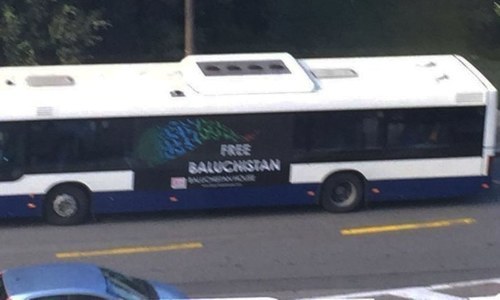
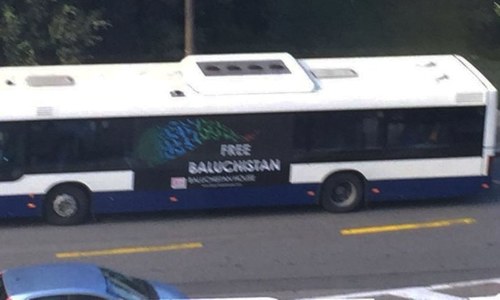
Posters demanding freedom for Jammu and Kashmir and Indian states Tripura, Nagaland, and Manipur have appeared on metro buses and trams in Geneva while the 36th session of the United Nations Human Rights Council (UNHRC) is underway in the city.
The Pakistan Television Network (PTV) official Twitter account shared this information on Monday night with images. It has yet to be ascertained who put up the posters.
Earlier in September, Ambassador Farukh Amil, the permanent representative of Pakistan to the UN had written to the Swiss authorities to bring attention to “Free Balochistan” posters that had cropped up in the area around Rue de Ferney of Grand Saconnex in Geneva.
In his letter, Ambassador Amil had demanded that the Swiss authorities take action against the posters after reports of their sighting.
Ambassador-designate of Switzerland, Thomas Kelly, was also summoned to the Foreign Office (FO) by Additional Secretary (Europe) Zaheer A. Janjua to lodge a protest against the display of "anti-Pakistan posters and an insidious paid campaign against Pakistan", an FO handout read.
On Sept 21, the Senate agreed to suspend till further notice the workings of a Pak-Switzerland Friendship Group in reaction to the appearance of "Free Balochistan" posters in Geneva.
Senate Chairman Raza Rabbani claimed that the posters were an attack on Pakistan's sovereignty and demanded to know from Law Minister Zahid Hamid why the posters continue to be displayed in Switzerland even though Pakistan had summoned the Swiss ambassador and recorded its protest.
"According to the United Nations' Charter, no country can allow its soil to be used against another state," Rabbani had stated.
Senators had insisted on expelling the Swiss ambassador from the country, echoing Rabbani's demand from a day earlier.
Hotly debated dispute
Pakistan and India's longstanding dispute regarding the Jammu and Kashmir territory was hotly debated during last week's UN General Assembly session.
On Sept 23, India's External Affairs Minister Sushma Swaraj took a swipe at Pakistan, telling the UN General Assembly that Islamabad had given the world "terrorists" while India was producing top-notch doctors and engineers.
In her diatribe, she had said, "Pakistan is recognised only as the pre-eminent export factory for terror."
Responding to the charges levelled by Swaraj Pakistan's Permanent Representative to the United Nations Maleeha Lodhi had said that India was using terrorism as a state policy.
“Her comments towards my country betray the hostility that the Indian leadership has towards Pakistan —the hostility we have endured for 70 years,” Ambassador Lodhi had told the assembly.
The Pakistani diplomat had said that India's military occupation of the State was illegal as the UN Security Council had, in over a dozen resolutions, decided that the dispute must be resolved by enabling the people of Jammu and Kashmir to determine their own destiny through a UN-supervised plebiscite.