India's top court rules instant 'triple talaq' divorce unconstitutional



India's top court on Tuesday struck down the controversial Islamic practice that allows men to divorce their wives instantly by a 3:2 majority, deeming it "unconstitutional".
The Supreme Court (SC) ruled that the practice of “triple talaq”, whereby Muslim men can divorce their wives by reciting the word talaq (divorce) three times, was both unconstitutional and un-Islamic.
Victims including Shayara Bano, whose husband used triple talaq to divorce her by letter in 2015, had approached India's highest court to ask for a ruling.
Examine: Indian, Muslim and female
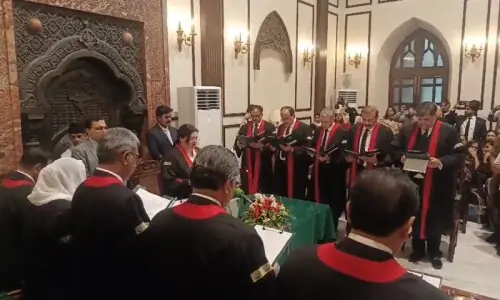
A panel of five judges from India's major faiths — Hinduism, Christianity, Islam, Sikhism and Zoroastrianism — said triple talaq was “not integral to religious practice and violates constitutional morality”.
They said it was “manifestly arbitrary” to allow a man to “break down (a) marriage whimsically and capriciously”.
“What is sinful under religion cannot be valid under law,” said the judges.
Indian Chief Justice JS Khehar, who was a part of the panel, asked the government to bring legislation in six months to govern marriage and divorce in the Muslim community, Times of India reported.
Bano, who suffered a nervous breakdown after her divorce, said it was a “historic occasion” for Muslim women.
“I appeal to the people to not politicise this issue and accept Supreme Court's verdict on triple talaq,” she told reporters outside the court.
“I have felt the pain when family breaks. I hope no one has to go through this situation in future.”
India, which is officially secular, is one of the few nations that legally permitted the practice, which is banned in neighbouring Bangladesh.
India allows religious institutions to govern matters of marriage, divorce and property inheritance in the multi-faith nation, enshrining triple talaq as a legal avenue for its 180 million Muslims to end unions.
But the Hindu nationalist government of Prime Minister Narendra Modi had backed the petitioners in this landmark case, declaring triple talaq unconstitutional and discriminatory against women.
Modi's ruling Bharatiya Janata Party has long pushed for a uniform civil code, governing Indians of all religions, to be enforced.
Maneka Gandhi, India's minister for women and children, said the ruling was a “giant step for women”.
“Divorce is a very, very important part of a woman's life,” she said in an interview with the News18 television channel.
“This makes her as equal as she is entitled to be under the constitution.”
The All India Muslim Personal Law Board (AIMPLB), a grouping of Islamic organisations, had opposed any efforts to ban triple talaq.
The board said the practice was “reprehensible” but should not be a matter for the courts or the government.
Some Islamic scholars say there is no mention of triple talaq in the Holy Quran, which instead details a different process for divorce based on mediation.
The practice had been challenged in lower courts but it was the first time India's Supreme Court had considered whether triple talaq was legal.