0
0

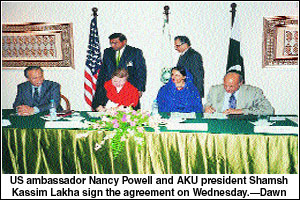 KARACHI, Aug 13: The United States Agency for International Development (USAID) will give $4.5 million to Aga Khan University to establish an alternative examination board for secondary and higher secondary education.
US ambassador Nancy Powell and Aga Khan University president Shamsh Kassim Lakha signed a cooperative agreement on Wednesday to set up the examination board, which would be the first in the private sector.
An ordinance establishing the Aga Khan University Examination Board was approved by the government in Nov 2002.
Ms Powell said the establishment of the AKU examination board would help meet one of the major objectives of improving access to and quality of primary and secondary education in Pakistan.
She recalled that at a recent meeting between US President George Bush and Gen Pervez Musharraf at Camp David, the leaders had singled out education as a sector vital for the future, economic growth and stability of Pakistan.
Terming the AKU examination board a “new opportunity” to improve the quality of teaching and learning in the country, the US ambassador said the project would reinforce three very important principles at the heart of education sector reforms.
She said that firstly the alternative examination board in the private sector would strongly influence future policy debate. Secondly, she said, it would emphasize the importance of teachers’ training and follow-up for helping students understand and apply knowledge. Thirdly, it was also a very good example of public-private partnership, she said.
Ms Powell said the grant would lay the foundation of future international and domestic financial support to ensure the sustainability of the examination board.
“More importantly we trust that when we look back on this occasion in five years’ time, we will say that this was the beginning of a significant change in how teachers instruct and how students learn in Pakistan,” said the US ambassador.
The federal minister for education, Zobaida Jalal, said that in the emerging knowledge-based economies of the world, critical thinking and intelligent access to knowledge pools was the need of the hour.
She added that the education boards in the country should recognize this need and respond accordingly.
She said that examinations for secondary school certificate and higher secondary certificate were conducted by some 23 boards of intermediate and secondary education, established by acts of the four provincial assemblies and the National Assembly.
Ms Jalal spoke about a lack of transparency in the examination system which had caused a decline in the quality of education in the country. She said that in recent years the number of students appearing in O- and A-Level examinations had increased five times because these examinations were credible all over the world.
She said: “The people of the country have been demanding alternatives. The setting up of the AKU examination board and the Askari Board are a logical response by the government in its bid to introduce education reforms. We know that quality costs, but we are also aware that education should be available for everybody. The AKU examination board will be accessible to private schools and public schools in the federally administered areas as well as in cantonment/garrison areas. However, the exam fee may not be affordable to many households.”
She urged the AKU to attach importance to equity issues in the public interest.
The education minister was confident that competition in the education sector would get the existing examination boards to upgrade their systems.
She said the AKU initiative should be monitored closely and reported at regular intervals.
In his welcome address, Mr Lakha said the establishment of an alternative examination board was in accordance with the policy of the government of making an independent evaluation body through private-public partnership.
He said the examination board would offer high-quality examination in Urdu and English to students of government schools in federally administered areas and to private schools anywhere in Pakistan at an affordable cost.
Mr Lakha said the AKU examination board, which had started its operations in July 2003, expected to offer the first SSC examination by the summer of 2006 and the HSC examination by 2008.
Former ambassador Saidullah Dehlavi, Consul-General of the US in Karachi Douglas C. Rohn, Sindh education minister Irfanullah Khan Marwat, minister for women development Saeeda Malik, USAID country director Mark Ward also attended the ceremony.