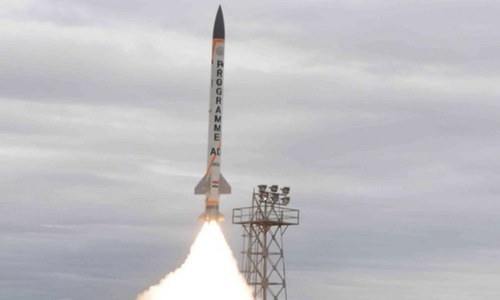
The Foreign Office (FO) on Thursday termed the change in India’s nuclear arms usage policy as “highly irresponsible and dangerous” and said it will "not help in promoting strategic restraint and stability in a nuclearised South Asia".
“Pakistan has long maintained that the ambiguous no-first-use declaration is not verifiable and hence nothing more than an empty political statement,” said FO spokesman Nafees Zakaria.
The spokesman added that such ambiguous declaration cannot substitute for verifiable arms control and restraint measures.
“Pakistan has to consider capabilities and not intentions, which can change anytime,” said the FO spokesman in its weekly briefing.
Earlier, former defence secretary retired Lt Gen Naeem Khalid Lodhi claimed that Pakistan possesses second strike capability against India.
The second strike provides a military with the capability to hit back at an enemy in a situation where its land-based nuclear arsenal had been neutralised.
The nuclear deterrence, said the former defence secretary, had been augmented by the second strike capability, efficient delivery systems and effective command and control system.
Pakistan, in January 2017, attained the credible ‘second strike capability’ after successfully test-firing nuclear capable submarine-launched cruise missile (SLCM) Babur-III.
“The successful attainment of a second strike capability by Pakistan represents a major scientific milestone; it is a manifestation of the strategy of measured response to nuclear strategies and postures being adopted in Pakistan’s neighbourhood,” the military said after the test.
The 450km range Babur-III, a sea-based variant of Babur-II — a ground-launched missile — was test-fired from a mobile platform in the Indian Ocean to hit a land-based target at an undisclosed location.
The land-attack mode Babur-III is said to be capable of delivering various types of payloads. The successful test, analysts say, would help stabilise the deterrence that had been strained because of India’s sea-based missiles K-4, K-15, Dhanush and Brahmos, which has got land, air and sea versions.